
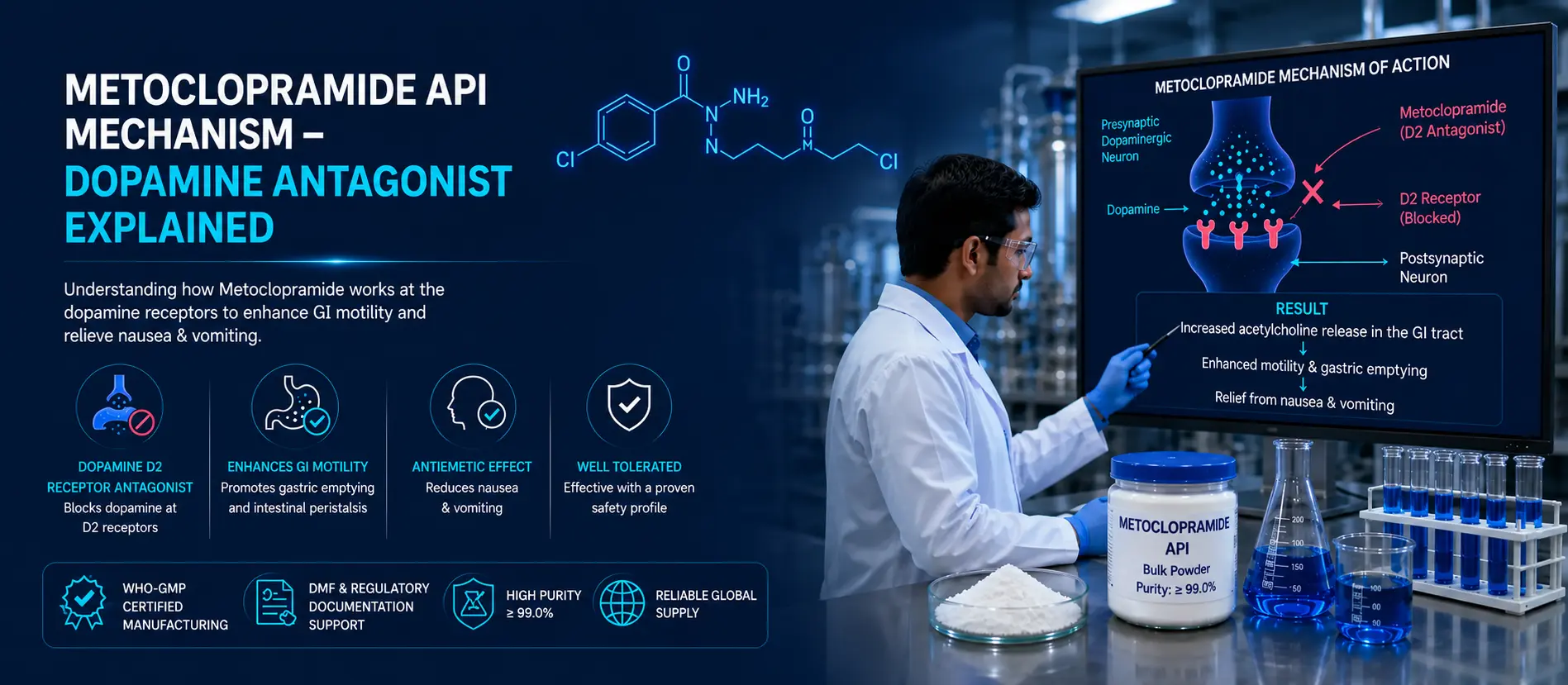
Metoclopramide API Mechanism: The Dopamine Antagonist Explained
Metoclopramide API Mechanism: The Dopamine Antagonist Explained
Last Updated: July 2026 | Reviewed against current pharmacological and pharmacopoeial references
Written for formulators, regulatory reviewers and procurement teams. Pharmacology is summarised for technical context; prescribing decisions sit with qualified clinicians.
TL;DR: Metoclopramide works mainly as a dopamine D2 receptor antagonist. Blocking D2 receptors in the brain’s chemoreceptor trigger zone stops nausea; blocking them in the gut, together with serotonin 5-HT3 antagonism and 5-HT4 agonism, speeds gastric emptying. That dual central-and-peripheral action is what makes it both an anti-emetic and a prokinetic. This guide explains the mechanism receptor by receptor and why it matters when sourcing the API.
The Core Mechanism: Dopamine D2 Antagonism
Metoclopramide API is, first and foremost, a dopamine D2 receptor antagonist. Dopamine normally acts as a brake on gut motility and as a trigger for nausea. By blocking D2 receptors, metoclopramide releases that brake and quietens that trigger at the same time.
It does this in two places:
- Centrally, in the chemoreceptor trigger zone within the area postrema of the brainstem – the region that initiates the vomiting reflex. Antagonising D2 receptors here suppresses nausea and vomiting.
- Peripherally, in the gastrointestinal tract, where the same D2 blockade removes dopamine’s inhibitory effect on smooth muscle and allows normal peristalsis to resume.
One molecule, two sites of action. That is the whole reason a single API can settle nausea and restart a stalled stomach in the same dose.
Beyond Dopamine: Serotonin Receptor Activity
Metoclopramide is not a pure dopamine antagonist. At therapeutic and higher concentrations it also acts on serotonin receptors, and this is what sharpens its prokinetic effect:
| Receptor | Action | Effect |
| Dopamine D2 | Antagonist | Suppresses nausea centrally; releases the motility brake peripherally |
| Serotonin 5-HT3 | Antagonist | Adds to the anti-emetic effect, especially at higher doses |
| Serotonin 5-HT4 | Agonist | Enhances acetylcholine release in the gut wall, strengthening contractions |
The 5-HT4 agonism is the underrated part. By promoting acetylcholine release from enteric neurons, it amplifies the coordinated contractions that move contents through the upper gut – reinforcing what the D2 blockade begins.
What the Mechanism Does to the Gut
Translate the receptor pharmacology into plumbing and it becomes concrete. Metoclopramide:
- Raises the resting tone of the lower oesophageal sphincter, which reduces reflux
- Increases the amplitude and duration of oesophageal and gastric contractions
- Relaxes the pyloric sphincter and duodenal bulb so the stomach can discharge into the small intestine
- Increases peristalsis in the duodenum and jejunum
The net result is faster, better-coordinated gastric emptying. Importantly, it achieves this without increasing gastric acid secretion – a distinction that matters in the post-operative setting and separates it from some other GI agents.
Because the drug acts on the vomiting centre as well as the gut, its effect is felt centrally too – which also explains its adverse-effect profile, since the same central D2 blockade that stops nausea can, with prolonged use, produce movement-related effects. That safety detail sits with the prescriber; for the API buyer, the takeaway is that receptor selectivity and impurity control are not academic concerns.
Why Mechanism Matters to an API Buyer
A mechanism discussion can feel like a clinical topic that stops at the pharmacy shelf. It does not. For a formulator or procurement lead, three things follow directly from how metoclopramide works:
- Purity drives the intended action. The receptor activity described above is the activity of metoclopramide itself. Related substances and process impurities do not share that clean profile, which is why a tight impurity specification is a pharmacological requirement, not just a regulatory one.
- The salt form matters. Metoclopramide Hydrochloride (CAS 54143-57-6, molecular weight 336.3 g/mol) is the form used in most oral and injectable products; the base (CAS 364-62-5, molecular weight 299.8 g/mol) is used where the formulation calls for it. The mechanism is the same; the handling and formulation are not.
- Consistency protects the dose-response. Because the effect spans central and peripheral receptors, batch-to-batch consistency in assay and impurity profile is what keeps the clinical response predictable.
For the indications this mechanism supports – diabetic gastroparesis, GERD and nausea and vomiting – see our companion guide, “What is Metoclopramide API? Uses in GI Disorders“.
Bio-Synth has manufactured APIs since 1943 from Balanagar, Hyderabad, under WHO-GMP certification from the Drugs Control Administration, Government of Telangana, and ISO 9001:2015 certification, following ICH Q7 principles. For Metoclopramide Hydrochloride it holds a product-specific EU Written Confirmation (WC-0274) covering the IP/USP grades, and supplies the API against IP, BP, Ph.Eur and USP monographs alongside its wider quality systems.
FAQs
1. What is the mechanism of action of metoclopramide?
It is primarily a dopamine D2 receptor antagonist. It blocks D2 receptors centrally in the chemoreceptor trigger zone to suppress nausea, and peripherally in the gut to increase motility. It also antagonises serotonin 5-HT3 receptors and acts as a 5-HT4 agonist, which strengthens its prokinetic effect.
2. Is metoclopramide a dopamine agonist or antagonist?
An antagonist. It blocks dopamine D2 receptors rather than activating them, which is what produces both its anti-emetic and its prokinetic effects.
3. How does metoclopramide speed up gastric emptying?
By raising lower-oesophageal-sphincter tone, increasing the strength of stomach contractions, relaxing the pyloric sphincter and increasing peristalsis in the duodenum and jejunum – without increasing gastric acid secretion.
4. What role do serotonin receptors play?
Metoclopramide antagonises 5-HT3 receptors (adding to the anti-emetic effect) and activates 5-HT4 receptors (promoting acetylcholine release in the gut wall, which enhances motility). These serotonergic actions complement the core dopamine antagonism.
5. Why does the mechanism matter when buying the API?
Because the receptor activity belongs to metoclopramide itself, not to its impurities. A tight impurity profile and consistent assay are what preserve the intended pharmacological action from batch to batch – making purity a functional requirement, not just a compliance one.


Post a comment