
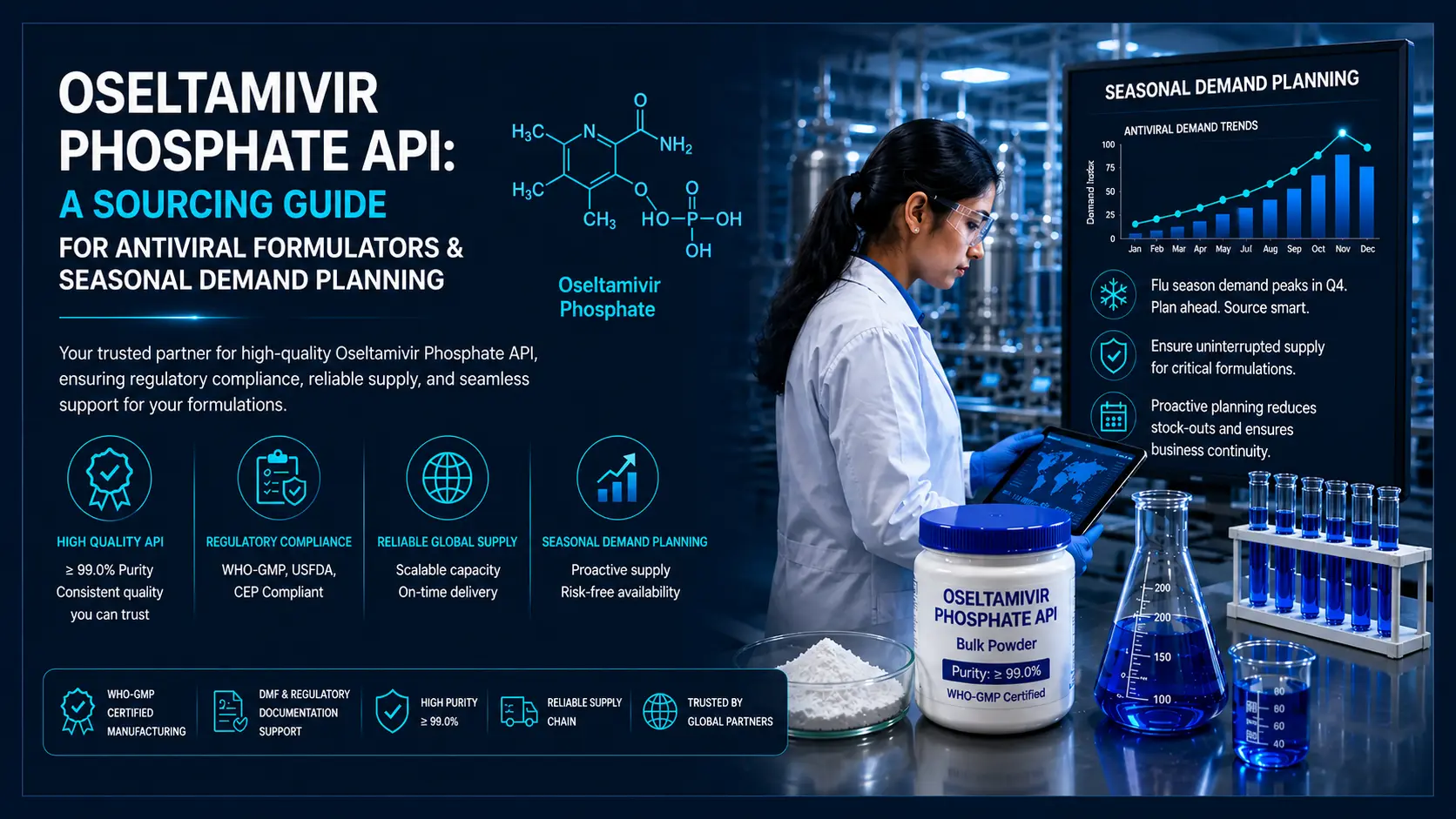
Oseltamivir Phosphate API: A Sourcing Guide for Antiviral Formulators and Seasonal Demand Planning
Oseltamivir Phosphate API: A Sourcing Guide for Antiviral Formulators and Seasonal Demand Planning
Last Updated: July 2026 | Reviewed against current pharmacopoeial and ICH guidance
Written for antiviral formulators, procurement teams and regulatory reviewers. Clinical detail is summarised for context; prescribing sits with qualified clinicians, and documentation requirements vary by market and registration route.
TL;DR: Oseltamivir Phosphate is the antiviral API behind oral influenza therapy – a neuraminidase inhibitor active against influenza A (including pandemic H1N1) and B. Demand for it is seasonal and occasionally spikes without warning, which makes forward planning the real sourcing challenge. This guide covers the API-grade specification, what to check in a supplier, and how to plan procurement around a flu-season cycle rather than chasing it.
What Oseltamivir Phosphate API Is
Oseltamivir Phosphate API is an oral antiviral in the neuraminidase inhibitor class, used for the treatment and prophylaxis of influenza A (including pandemic H1N1) and influenza B. It is the active ingredient in the oral capsules and suspensions dispensed each flu season.
| Property | Value |
| Category | Neuraminidase inhibitor (antiviral) |
| Chemical name | Ethyl (3R,4R,5S)-5-amino-4-acetamido-3-(pentan-3-yloxy)-cyclohex-1-ene-1-carboxylate |
| Molecular formula | C16H31N2O8P (phosphate salt) |
| Molecular weight | 410.40 g/mol |
| Appearance | White to off-white powder |
| Solubility | Freely soluble in water, soluble in DMSO, slightly soluble in DMF |
The free water solubility is convenient for oral solid and suspension formulations, and the well-defined stereochemistry – three specified chiral centres – is a reminder that the synthesis and its impurity control are not trivial.
How It Works, in Brief
Oseltamivir is a prodrug that inhibits viral neuraminidase, the surface enzyme influenza uses to release newly formed virus particles from an infected cell. Block the enzyme and the new virions stay stuck to the host cell, which halts spread to neighbouring cells and limits the infection.
Two practical points follow from that mechanism. First, the clinical benefit is greatest when treatment starts within 48 hours of symptom onset – timing that shapes how the finished product is distributed and stocked. Second, because the drug works by stopping viral release rather than killing the virus outright, consistent potency matters: an under-strength batch does not simply work a little less, it works late.
The API-Grade Specification
This is where a sourcing conversation should start, and it is the part patient-facing pages never cover. For antiviral formulators, the numbers that matter are the release specification, not the dosing table.
| Parameter | Specification |
| Assay (HPLC) | Not less than 98% w/w |
| Total impurities | Not more than 1.0% w/w |
| Any unspecified impurity | Not more than 0.5% w/w |
A compliant Certificate of Analysis should carry these alongside appearance, identification, residual solvents, water content and heavy metals, each against the applicable European Pharmacopoeia (EP) monograph. Read the CoA against your own registration route before you commit – the grade you need is set by your destination market, not by the lowest quote.
Planning Around a Seasonal Demand Cycle
Oseltamivir is not a steady-state product. Demand tracks the influenza calendar – building through autumn, peaking in winter across each hemisphere, then falling away – and every few years a pandemic scare or a bad strain sends it vertical with no notice. That pattern is the single most important thing to plan for.
A few principles hold up season after season:
- Order against the calendar, not the outbreak. By the time a flu season is in the headlines, API lead times are already stretched. The buyers who secure supply are the ones who placed orders in the quiet months.
- Build a buffer for the tail risk. Pandemic-preparedness and government-stockpiling demand does not follow the seasonal curve. A supply agreement that can flex upward is worth more than the lowest per-kilogram price.
- Qualify a supplier before you need them. Audits, documentation review and sample evaluation take weeks. Doing that work in the off-season means you can actually place a real order when demand turns.
- Confirm the supplier’s own capacity rhythm. A partner who runs Oseltamivir campaigns predictably is more useful in a spike than one who makes it only to order.
The recurring nature of flu season is an advantage for anyone who treats it as a plan rather than a surprise. The demand is going to come; the only variable is whether your supply was arranged in advance.
What to Check in a Supplier
Run the same checks you would on any API, with the seasonal layer on top:
- Certificate scope. A WHO-GMP certificate covers a site against named products; read what it actually covers. Confirm any EP or CEP status directly – “in process” is not the same as “granted”.
- Full documentation. Batch-wise CoAs against the EP monograph, impurity and stability data, and a clear answer on regulatory filings for your market.
- Capacity and lead time. Ask what a realistic lead time looks like in-season versus off-season, and whether the supplier holds any buffer stock.
- Consistency across campaigns. Assay and impurity profile should not drift between a quiet-season batch and a peak-season one.
Getting the paperwork questions settled early is what separates a supply that holds in a spike from one that fails when you need it. Incomplete documentation delays more launches than manufacturing does.
Sourcing from Bio-Synth
Bio-Synth has manufactured APIs since 1943 and operates from Balanagar, Hyderabad. The site holds WHO-GMP certification issued by the Drugs Control Administration, Government of Telangana, and ISO 9001:2015 certification, and manufacturing follows ICH Q7 principles. Oseltamivir Phosphate is supplied against the EP monograph to the specification above, alongside the wider API portfolio and Bio-Synth’s quality systems.
For teams building an antiviral portfolio, Oseltamivir sits alongside other antiviral APIs such as Nirmatrelvir API, and the broader picture of API manufacturing in India is worth understanding before committing a seasonal program. To discuss volumes and documentation ahead of the next flu season, talk to Bio-Synth.
FAQs
1. What is Oseltamivir Phosphate API used for?
It is the active ingredient in oral influenza antivirals – a neuraminidase inhibitor used to treat and prevent influenza A (including pandemic H1N1) and influenza B. It is formulated into oral capsules and suspensions.
2. What is the API-grade specification?
Assay by HPLC not less than 98% w/w, total impurities not more than 1.0% w/w, and any unspecified impurity not more than 0.5% w/w, against the EP monograph. Full release testing also covers appearance, identification, residual solvents, water content and heavy metals.
3. Why is demand for Oseltamivir seasonal?
Because influenza itself is seasonal. Demand builds through autumn, peaks in winter, and falls in the off-season – with occasional sharp spikes driven by pandemic scares or severe strains. Planning procurement against the calendar, rather than reacting to an outbreak, is the core sourcing skill.
4. When should a formulator place Oseltamivir API orders?
In the quiet months, ahead of the season. In-season lead times stretch as demand rises, so buyers who secure supply early are the ones who have it when they need it.
5. What should I verify before sourcing?
Certificate scope (site versus product), a full CoA against the EP monograph, impurity and stability data, realistic in-season lead times, and batch-to-batch consistency across campaigns.


Post a comment