What is Bedaquiline API? Uses in MDR-TB Treatment
What is Bedaquiline API? Uses, Mechanism & MDR-TB Treatment
Introduction
Tuberculosis has plagued humanity for centuries. Standard TB is treatable. Multidrug-Resistant Tuberculosis (MDR-TB) is not – at least, not easily.
MDR-TB resists isoniazid and rifampicin. These are the two most effective first-line TB drugs. When they fail, patients face treatment regimens lasting up to two years, heavy drug side effects, and low success rates.
In 2012, that changed. The USFDA approved Bedaquiline – the first new anti-TB drug in over 40 years with a completely original mechanism. It has since become a cornerstone of MDR-TB treatment globally.
This article explains what Bedaquiline API is, how it works, and why it matters for pharmaceutical manufacturers and procurement teams.
What is Bedaquiline API?
An Active Pharmaceutical Ingredient (API) is the compound in a medicine that produces the therapeutic effect. Bedaquiline is the API used in MDR-TB formulations.
It belongs to a drug class called diarylquinolines. It works differently from every anti-TB drug developed before it. Clinicians always prescribe it as part of a combination regimen – never as a single agent.
Key technical details:
| Parameter | Details |
|---|---|
| Chemical Name | (1R,2S)-1-(6-Bromo-2-methoxy-3-quinolyl)-4-dimethylamino-2-(1-naphthyl)-1-phenylbutan-2-ol |
| CAS Number | 845533-86-0 |
| Molecular Formula | C₃₂H₃₁BrN₂O₂ |
| Commercial Form | Bedaquiline Fumarate |
| Category | Anti-Tuberculosis (MDR-TB) |
| Drug Class | Diarylquinoline / ATP Synthase Inhibitor |
Bio-Synth manufactures Bedaquiline API and supplies it to pharmaceutical companies worldwide for use in finished MDR-TB medicines.
Why MDR-TB Demanded a New Drug
The WHO reported 410,000 new MDR-TB cases in 2022. Old treatment regimens lasted 18–24 months. Success rates were below 60%. Many patients suffered hearing loss or kidney damage from the drugs used.
Bedaquiline changed the outcome. When included in the BPaL regimen (Bedaquiline + Pretomanid + Linezolid), clinical trials recorded success rates above 80–90% – even in extensively drug-resistant TB (XDR-TB). That improvement is why demand for this API has grown every year since its approval.
How Bedaquiline API Works
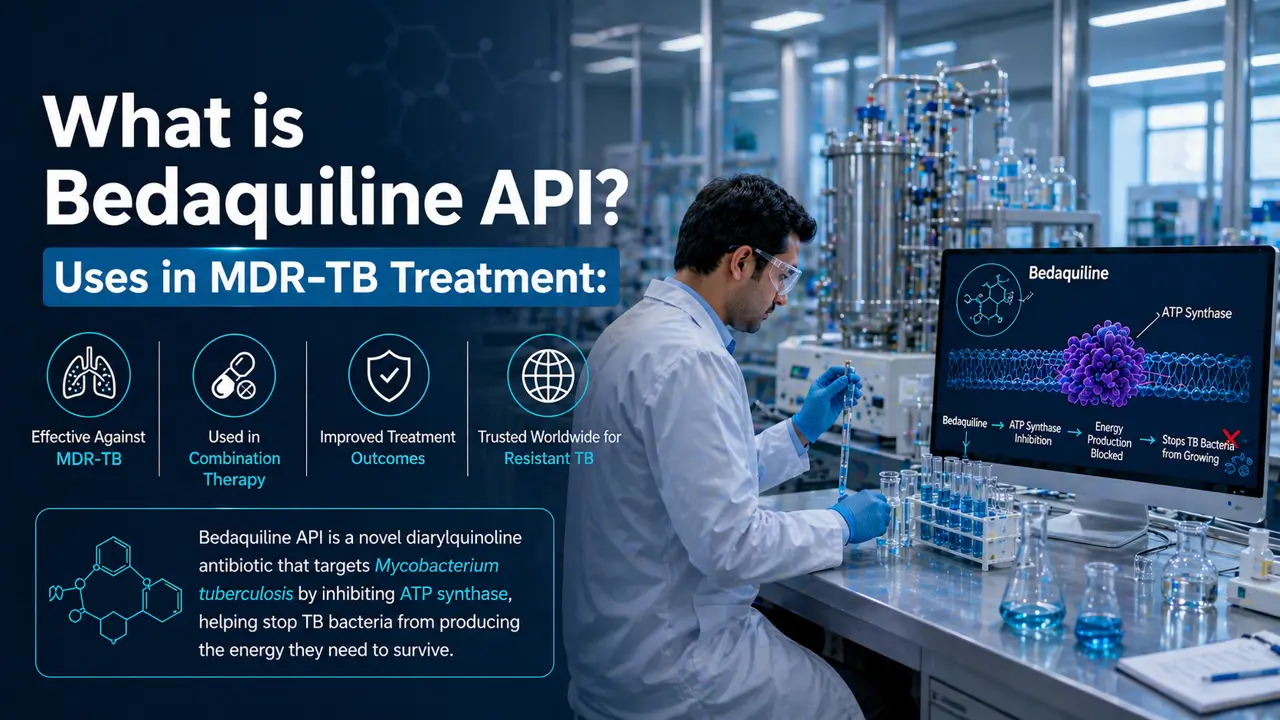
Bedaquiline has a unique mechanism. It targets an enzyme called F₁F₀-ATP synthase – the engine that powers Mycobacterium tuberculosis (Mtb).
This enzyme produces adenosine triphosphate (ATP), which is the energy source all cells depend on. Bedaquiline blocks it. When ATP production stops, the bacteria die.
What makes this especially powerful is its reach:
- Active bacteria – Bedaquiline shuts down replicating cells directly.
- Dormant bacteria – Even inactive Mtb needs minimal ATP to survive. Bedaquiline cuts off that supply too. This matters because dormant bacteria cause most TB relapses.
Bedaquiline is also selective. The mycobacterial ATP synthase is structurally different from the human version. Bedaquiline targets the bacterial enzyme with high specificity, leaving human cells largely unaffected. This is why it is better tolerated than many older second-line TB drugs.
Clinical Uses of Bedaquiline API
Multidrug-Resistant TB (MDR-TB) This is Bedaquiline’s primary indication. MDR-TB strains resist both isoniazid and rifampicin. The WHO classifies Bedaquiline as a Group A drug – its highest-priority category. It is used alongside levofloxacin or moxifloxacin and linezolid.
Extensively Drug-Resistant TB (XDR-TB) XDR-TB additionally resists fluoroquinolones and injectable drugs. Bedaquiline is central to the BPaL regimen tested in the TB-PRACTECAL and ZeNix trials – both of which showed strong results. BPaL is now a standard XDR-TB regimen in many countries.
Treatment-Refractory TB For patients who have failed multiple prior regimens, Bedaquiline remains one of the few active options. It is combined with pretomanid and delamanid in these cases.
Pediatric MDR-TB The WHO recommends Bedaquiline for children aged 5 and older. In some programs, younger children receive it with weight-adjusted dosing.
What Formulators Need to Know
Pharmaceutical companies developing Bedaquiline products must account for several API-specific factors.
Physical Form – Bedaquiline Fumarate is the preferred commercial form. It offers better stability and solubility than the free base.
Impurity Control – USFDA Drug Master File (DMF) and EMA Certificate of Suitability (CEP) submissions require strict identification and control of all process-related and degradation impurities.
Storage – Store in cool, dry conditions, away from light and moisture. Stability data must be included in the Certificate of Analysis (CoA) and Technical Dossier.
Particle Size – Particle size affects dissolution rate and bioavailability. Agree on specifications with your API supplier before beginning the qualification process.
Our blog on pharmaceutical API regulations and quality standards explains how GMP, WHO, and ICH requirements apply to APIs like Bedaquiline.
Global Demand: What is Driving Growth
Shorter regimens are now standard The WHO’s 2022 guidelines recommend the 6-month BPaL(C) regimen for XDR-TB and select MDR-TB cases. Shorter regimens mean more patients complete treatment – and that drives sustained API procurement.
Generic manufacturing has expanded Voluntary licensing through the Medicines Patent Pool (MPP) allows qualified Indian manufacturers to produce Bedaquiline API legally for high-burden markets. Supply has grown. Prices have become more accessible.
High-burden countries are procuring at scale India, South Africa, Russia, Indonesia, China, and the Philippines all face large MDR-TB caseloads. National TB programs in these countries – funded by the Global Fund and domestic health budgets – are increasing Bedaquiline purchases year on year.
Bedaquiline Within the Anti-TB API Ecosystem
MDR-TB treatment always requires a combination of APIs. Bedaquiline does not work alone.
Bio-Synth has manufactured anti-TB APIs since 1943. Our anti-TB portfolio includes Aminosalicylate Sodium (PAS Sodium) – one of the earliest TB medicines ever produced – as well as Moxifloxacin HCl and Bedaquiline.
To understand how these APIs work together in modern TB regimens, read: Anti-Tuberculosis: The Role of Bedaquiline.
Regulatory Approvals
| Regulatory Body | Status |
|---|---|
| USFDA | Accelerated approval December 2012 (Sirturo®); full approval followed |
| WHO | Generic versions WHO-prequalified for international procurement |
| EMA | Conditional authorisation 2013; converted to full approval |
| India (CDSCO) | Included in national MDR-TB guidelines; procured under NTEP |
Pharmaceutical companies sourcing Bedaquiline API from India need complete regulatory documentation – DMFs, CEPs, and GMP certificates. Our advanced drug intermediates and API manufacturing page outlines how Bio-Synth supports buyers through this process.
Why Source Bedaquiline API from India?
Cost without compromise – Indian manufacturers integrate starting material and intermediate production in-house. This reduces cost at every stage and passes savings to buyers without sacrificing quality.
Regulatory credibility – India’s leading API manufacturers operate under WHO-GMP and ISO-certified systems. They routinely file DMFs with the USFDA and submit dossiers to the EMA.
Stable supply chains – Most Bedaquiline intermediates are produced domestically in India. This reduces dependency on global imports and supports reliable delivery.
Legal production rights – MPP voluntary licenses permit qualified Indian manufacturers to produce and supply Bedaquiline API to eligible low- and middle-income countries.
Bio-Synth: Trusted Bedaquiline API Manufacturer in India
Bio-Synth (Biochemical & Synthetic Products Pvt. Ltd.) has manufactured pharmaceutical APIs and intermediates since 1943 – over 80 years of experience. Our WHO-GMP and ISO 9001:2015 certified facilities are based in Balanagar, Hyderabad.
What sets Bio-Synth apart:
- In-house intermediates – We produce Bedaquiline-related intermediates ourselves, giving us control over quality, lead times, and cost.
- Batch-level testing – Every batch is tested under cGMP and GLP standards before release.
- Full documentation – CoA, TDS, SDS, and DMF support provided to all qualified buyers.
- Global reach – We supply customers across India, Europe, Asia, and North America through our US subsidiary, Biosynth Inc.
FAQs
Q: What is Bedaquiline API used for?
A: It is the active ingredient in MDR-TB and XDR-TB medicines. Always used in combination with other anti-TB agents. The WHO classifies it as a Group A – highest priority – drug in MDR-TB treatment.
Q: What is the CAS number of Bedaquiline?
A: 845533-86-0. This number identifies the compound across all regulatory filings and commercial documentation.
Q: How does Bedaquiline kill TB bacteria?
A: It blocks the F₁F₀-ATP synthase enzyme, cutting off ATP production. Without energy, bacteria cannot survive. It works on both active and dormant bacteria – reducing the risk of relapse.
Q: Is generic Bedaquiline API available?
A: Yes. The Medicines Patent Pool has issued voluntary licenses to qualified Indian manufacturers, allowing legal production and supply to eligible markets.
Q: What documents are needed to source Bedaquiline API from India?
A: CoA, SDS, and Technical Data Sheet are standard. For regulated markets, a DMF reference may also be required. Contact Bio-Synth – we provide the documentation your market needs.
Q: What is the difference between Bedaquiline and Bedaquiline Fumarate?
A: Bedaquiline is the active compound (free base). Bedaquiline Fumarate is the salt form used in manufacturing – it offers better stability and is the commercially supplied form.
Conclusion
Bedaquiline API brought a genuinely new approach to MDR-TB treatment. It targets an enzyme no prior TB drug had reached. It works on dormant bacteria that cause relapse. It sits at the centre of regimens that treat XDR-TB in six months – a fraction of the time older approaches required.
Global demand for Bedaquiline API is growing as countries scale up these regimens. Manufacturers who supply it reliably and compliantly will be critical partners in this effort.
Bio-Synth has the experience, the certifications, and the infrastructure to be that partner.


Post a comment