
What Is Carvedilol API? Uses in Hypertension and Heart Failure
What Is Carvedilol API? Uses in Hypertension and Heart Failure
Last updated: September 2026. Scope: what Carvedilol API is, the conditions it is approved to treat, the dosage forms it goes into, and the pharmacopoeial grades a formulator can buy.
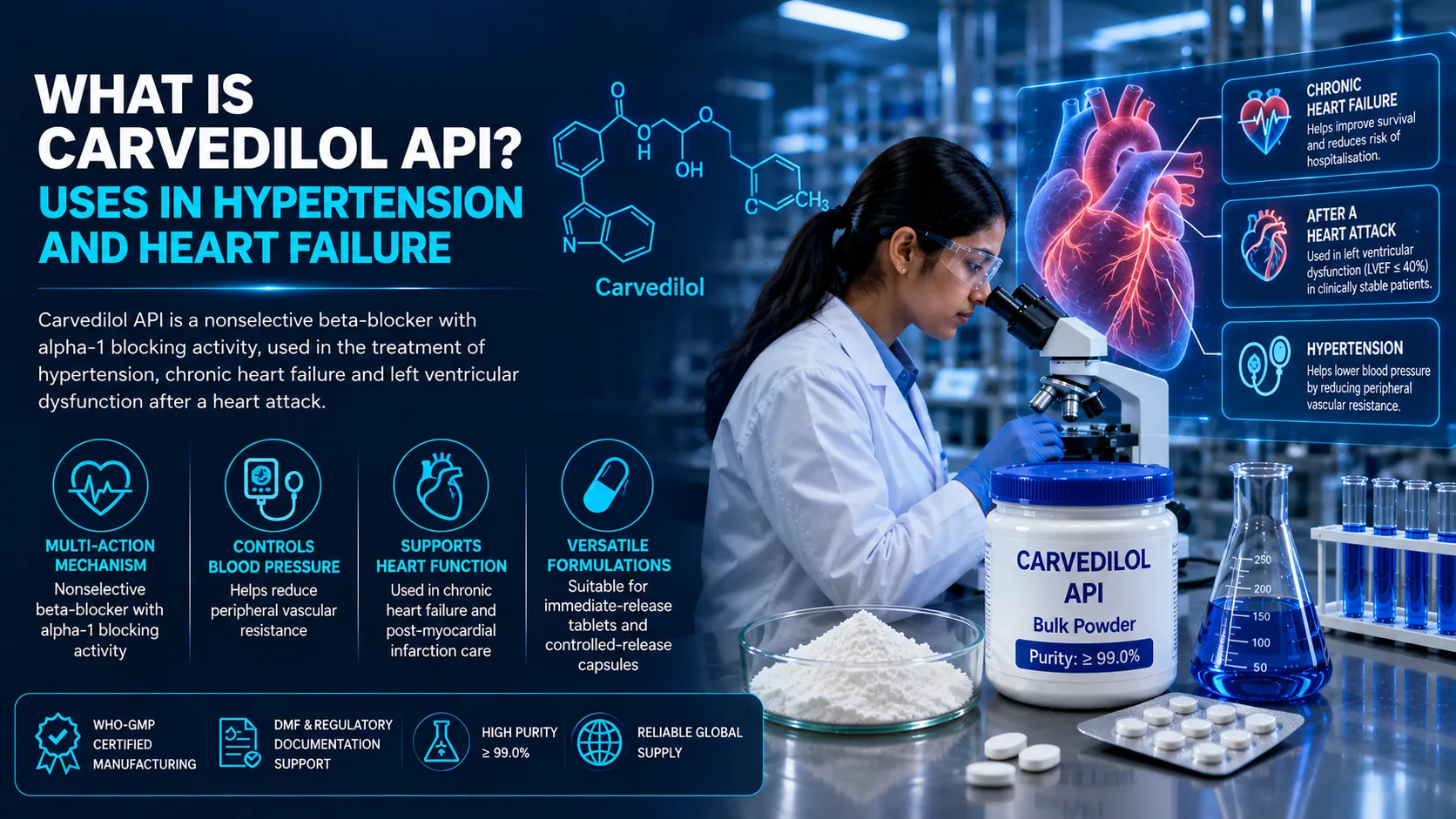
Carvedilol API (CAS 72956-09-3) is the active ingredient in carvedilol tablets and capsules. It is a nonselective beta-blocker with alpha-1 blocking activity, approved for chronic heart failure, left ventricular dysfunction after a heart attack, and essential hypertension. It is a white or almost white crystalline powder, practically insoluble in water, supplied to pharmacopoeial grade for immediate-release tablets and controlled-release capsules.
What Carvedilol API Is
Carvedilol is a beta-adrenergic blocking agent that also blocks alpha-1 receptors. The API is the pure drug substance before it is blended, granulated and compressed into a finished dose. Its chemical name is (2RS)-1-(9H-carbazol-4-yloxy)-3-[[2-(2-methoxyphenoxy)ethyl]amino]propan-2-ol. The molecular formula is C24H26N2O4 and the molecular weight is 406.47 g/mol. The pharmacopoeial name is Carvedilolum.
The structure has three parts that explain its behaviour: a carbazole ring, a propanolamine chain of the type found in most beta-blockers, and a methoxyphenoxyethyl group on the nitrogen. The (2RS) in the name means the API is a racemate, an equal mixture of the R(+) and S(-) enantiomers. The US prescribing information notes that the beta-blocking activity sits in the S(-) enantiomer while both enantiomers block alpha-1 receptors. The receptor pharmacology is covered in the companion post on the Carvedilol mechanism of action.
Physically, carvedilol is a white or almost white crystalline powder. It is practically insoluble in water, soluble in methylene chloride and methanol, sparingly soluble in ethanol, and freely soluble in dimethyl sulfoxide. That low water solubility is the single most important formulation property of the molecule, and it is why particle size and crystalline form are discussed with every supply of Carvedilol API.
Use in Chronic Heart Failure
The US prescribing information indicates carvedilol for mild-to-severe chronic heart failure of ischaemic or cardiomyopathic origin, usually in addition to diuretics, ACE inhibitors and digitalis, to increase survival and to reduce the risk of hospitalisation. The StatPearls monograph describes this population as heart failure with reduced ejection fraction.
In heart failure the drug is started low and titrated up over weeks. The immediate-release tablet strengths of 3.125 mg, 6.25 mg, 12.5 mg and 25 mg exist for that titration, with dosing from 3.125 mg twice daily up to 25 mg twice daily. For an API buyer this has a practical consequence. The lowest strength contains about 3 mg of drug in a tablet, so blend uniformity and content uniformity are demanding, and the particle size of the API is part of that conversation.
Use After a Heart Attack
The second approved indication is left ventricular dysfunction following myocardial infarction. The US prescribing information limits it to clinically stable patients who have survived the acute phase of a heart attack and have a left ventricular ejection fraction of 40% or less, with the aim of reducing cardiovascular mortality. The same titration principle applies.
Use in Hypertension
Carvedilol is indicated for the management of essential hypertension, alone or in combination with other antihypertensive agents, especially thiazide-type diuretics. Its alpha-1 blocking activity lowers peripheral vascular resistance, so it reduces blood pressure by widening vessels as well as by slowing the heart. The StatPearls monograph notes that it has a lesser effect on heart rate than pure selective beta-blockers and maintains cardiac output by reducing afterload.
Beyond the three approved indications, the StatPearls monograph lists off-label uses that include stable angina, atrial fibrillation, prophylaxis against variceal bleeding in cirrhosis, and management of ventricular arrhythmias. Those are clinical decisions, not label claims, and an API page should not present them as indications.
Dosage Forms Made From the API
Carvedilol reaches patients as immediate-release film-coated tablets in the four strengths above, taken twice daily, and as a once-daily controlled-release capsule. Both are oral solid dosage forms, and both are built on an API that is practically insoluble in water. The published dissolution literature classifies carvedilol as BCS Class II, with solubility that increases as pH falls because the secondary amine protonates. Formulators manage this through particle size, choice of crystalline form and, in the controlled-release product, through the release-controlling matrix. Food slows the rate of absorption of the immediate-release tablet without changing the extent, which is why the label recommends taking it with food.
Grades, Storage and Documentation
Bio-synth supplies Carvedilol API in IP, BP, and USP grades, and each batch is released with a Certificate of Analysis against the grade ordered. Storage follows the monograph for that grade: USP material is preserved in a tight container at controlled room temperature, and IP material is stored protected from light at a temperature not exceeding 30 °C.
Bio-synth’s site in Balanagar, Hyderabad, has manufactured APIs since 1943 and runs a quality management system certified to ISO 9001:2015. Its Carvedilol is made in line with ICH Q7 principles under the company’s own GMP declaration. The full list of tests, and the reasons each one matters, are in the companion post on Carvedilol API manufacturing and quality parameters. Carvedilol sits alongside the other cardiovascular and specialty molecules on the API portfolio page.
Frequently Asked Questions
What is the purpose of carvedilol?
Carvedilol is prescribed to treat chronic heart failure, to reduce cardiovascular mortality in stable patients with left ventricular dysfunction after a heart attack, and to manage essential hypertension. It works by blocking beta-1, beta-2 and alpha-1 adrenergic receptors.
What type of drug is carvedilol?
Carvedilol is a nonselective beta-adrenergic blocker with alpha-1 blocking activity. Because it widens blood vessels as well as slowing the heart, it is often grouped with the vasodilating beta-blockers.
What is the CAS number of Carvedilol API?
The CAS number of carvedilol is 72956-09-3. The molecular formula is C24H26N2O4 and the molecular weight is 406.47 g/mol.
Is Carvedilol API soluble in water?
No. Carvedilol is practically insoluble in water. It is soluble in methylene chloride and methanol and freely soluble in dimethyl sulfoxide. The published dissolution literature classifies it as a BCS Class II drug.
What strengths of carvedilol tablets are made from the API?
Immediate-release carvedilol tablets are made in 3.125 mg, 6.25 mg, 12.5 mg and 25 mg strengths. A once-daily controlled-release capsule is also marketed.
Which pharmacopoeial grades of Carvedilol API are available?
USP and IP grades are listed on the Carvedilol API product page, each with its own storage condition. Confirm the grade you need for your market before placing an order, and ask for the Certificate of Analysis for that grade.


Post a comment