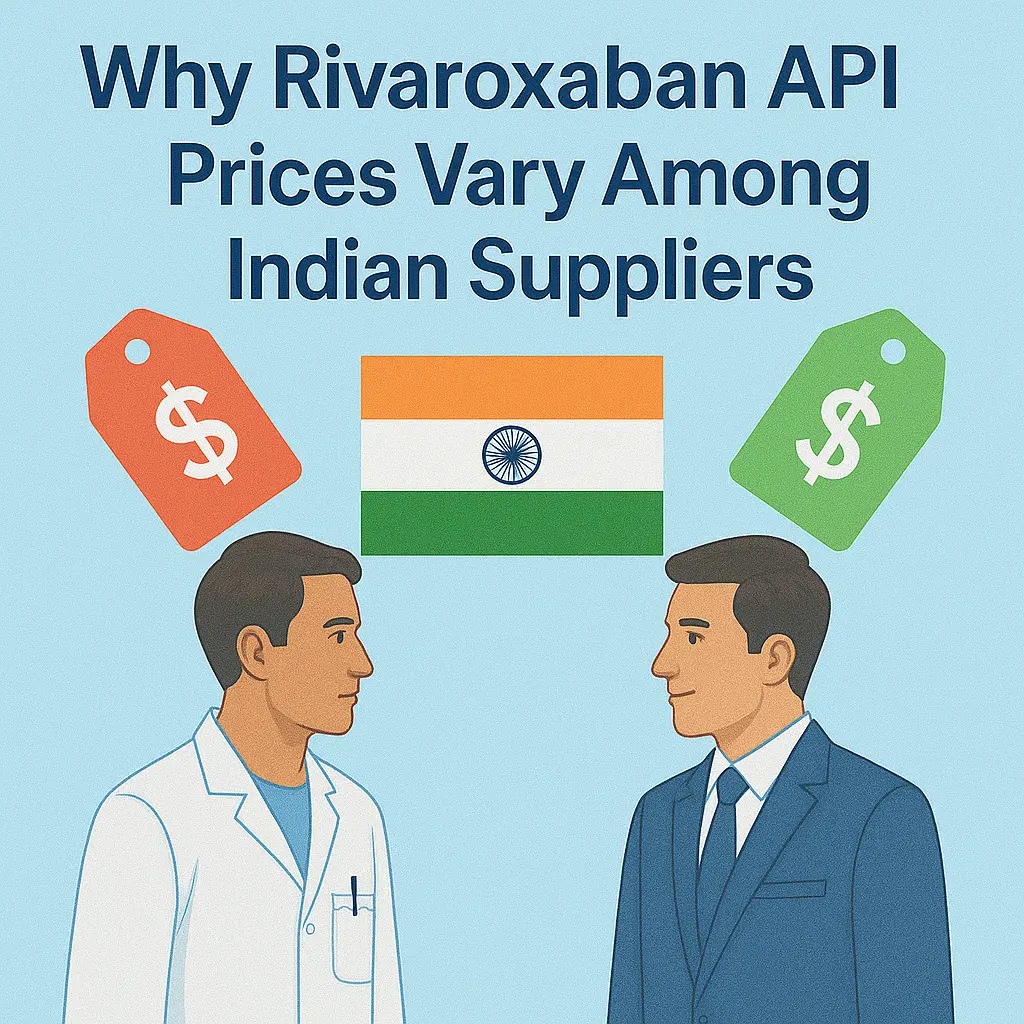
Why Rivaroxaban API Prices Vary Across Indian Suppliers
Why Rivaroxaban Price Varies Across Indian Suppliers: A Buyer’s Guide to Sourcing High-Quality API
The cost per kilogram for rivaroxaban API varies significantly across Indian suppliers due to differences in GMP compliance, impurity control, pharmacopoeial specification coverage, documentation readiness, and supply chain transparency. This guide helps B2B buyers understand those cost drivers and make informed, risk-managed procurement decisions.
Introduction: Understanding What Drives API Cost Variation
When procurement teams begin to evaluate the cost of anticoagulant drug substances sourced from India, the variation they encounter can be significant. The per-kilogram difference between suppliers is not random – it reflects real differences in quality systems, compliance investment, analytical capabilities, and documentation maturity. For a tablet drug that patients depend on for stroke and clot prevention, these differences carry direct clinical and regulatory consequences.
As one of India’s leading direct oral anticoagulant API manufacturers, Bio-Synth, based in Hyderabad’s Balanagar Industrial Area, leverages over eight decades of pharmaceutical manufacturing experience to supply consistent, high-purity API with full traceability, pharmacopoeial specification coverage, and documentation readiness for regulated and semi-regulated markets. Contact us to get latest price information, technical specifications, and documentation for your procurement requirements.
Industry & Regulatory References
The market insights and regulatory information in this article are based on: FDA and EMA guidance on DOAC manufacturing and approval pathways; ICH Q7 (Active Pharmaceutical Ingredients) and ICH Q11 guidelines; WHO GMP guidelines for pharmaceutical manufacturers; BP/Ph.Eur and USP pharmacopoeial monographs for this molecule; and global anticoagulant therapeutics market intelligence reports.
What Is This DOAC Tablet and Its Market Significance?
A direct oral anticoagulant (DOAC) used for preventing and treating thromboembolic disorders, this active pharmaceutical ingredient has become a critical medicine worldwide – especially in ageing populations prone to atrial fibrillation and deep vein thrombosis (DVT). Known by the brand name Xarelto (by Bayer) in branded markets, and widely available as a generic rivaroxaban tablet in regulated and semi-regulated markets, the drug offers predictable pharmacokinetics and simpler dosing than older anticoagulant medications like warfarin.
Key clinical context for formulation buyers:
- Indication: Prevention and treatment of DVT, pulmonary embolism, and stroke in patients with non-valvular atrial fibrillation.
- Dosage forms: Typically formulated as tablets in 2.5 mg, 10 mg, 15 mg, and 20 mg strengths – supplied as film-coated tablets in blister strip or bottle configurations.
- Prescribing: A doctor prescribes the appropriate dose and duration based on patient indication; medicines must be taken with or without food depending on dose.
- Side effects: The primary risk in patients is bleeding; doctor-supervised monitoring is essential, particularly during the initial treatment period.
- MRP and access: Branded Xarelto carries a high MRP in most markets. Generic rivaroxaban tablets – manufactured from compliant Indian API – enable significantly more affordable patient access through the pharmacy channel.
India supplies approximately 50% of global generic demand for advanced DOACs by volume. Manufacturers from Hyderabad, Gujarat, and Maharashtra collectively produce the API for generic rivaroxaban tablets that reach hospital pharmacies, retail pharmacy chains, and online pharmacy platforms globally. Not all suppliers are equal – and the variation in unit cost directly reflects that.
7 Key Factors Driving API Cost Differences in India
1. Manufacturing Setup & GMP Compliance
WHO-GMP and USFDA approvals play a major role in reliability and cost. Facilities that have invested in validated cleanrooms, automated process monitoring, and qualified QA systems carry higher fixed costs – but deliver a consistently compliant drug substance that protects the buyer’s regulatory position.
| Manufacturer Type | Compliance Status |
|---|---|
| WHO-GMP Certified (Tier 1) | WHO-GMP, CEP/DMF support, ISO 9001:2015 quality management |
| Price-Focused (Non-Certified) | Often unverified, limited documentation, variable batch quality |
In Hyderabad, Bio-Synth operates WHO-GMP approved facilities with validated synthesis conditions and automated process controls – ensuring stable supply and global export readiness for this anticoagulant API.
2. Quality Control & Impurity Profiles
This molecule has stringent purity requirements. Variability in cost often stems directly from the level of analytical investment made by the manufacturer to control impurity levels and pharmacopoeial compliance.
- Individual impurities controlled below 0.1% thresholds per applicable pharmacopoeial monograph
- Chiral purity confirmation to verify stereochemical consistency across batches
- Batch-to-batch repeatability across commercial scale runs
Technical Insight: This molecule contains a chiral centre, making stereochemical consistency during synthesis a critical quality parameter. Manufacturers employing validated asymmetric synthesis routes and chiral HPLC controls are better positioned to demonstrate pharmacopoeial compliance consistently across commercial batches. Residual solvent profiles and genotoxic impurity screening are additional areas where manufacturing process maturity directly affects regulatory acceptance – and where cost shortcuts taken by lower-tier suppliers create downstream risk for buyers.
3. Scale of Production
API producers in India range from small-scale outfits to vertically integrated manufacturers. Larger facilities in Hyderabad and Visakhapatnam benefit from:
- In-house intermediate production reducing procurement and yield risk
- Lower solvent costs through bulk purchasing agreements
- Optimised reaction yields reducing per-kilogram production cost
4. Supply Chain & Raw Material Sourcing
Inconsistent raw material input costs create significant pricing volatility across the supplier landscape. Tier-1 API manufacturers pre-contract approved vendors and audit their supply chains to reduce this uncertainty. Bio-Synth maintains multi-vendor raw material partnerships, ensuring cost stability even during periods of supply disruption.
5. Regulatory Documentation & Filing Status
API buyers targeting the EU, Japan, and Brazil require full regulatory dossiers. Suppliers offering complete documentation command price premiums over undocumented alternatives, but reduce total regulatory risk significantly.
- DMF or CEP filings for target regulatory jurisdictions
- Analytical method validation packages aligned with pharmacopoeial monographs (BP/Ph.Eur or USP)
- Stability data compliant with ICH Q1A for registration submissions
Documentation Note: Regulatory documentation such as batch-specific Certificates of Analysis (CoA), Material Safety Data Sheets (SDS/MSDS), and process-related technical files may be shared with qualified buyers subject to standard confidentiality and qualification procedures. Documentation requests are assessed on a case-by-case basis depending on project requirements and regulatory jurisdiction. Buyers should verify specific DMF or CEP status directly with the supplier at the time of enquiry.
6. CDMO Support and Custom Formulation Services
Some formulation buyers require customised particle sizing, micronisation, or specific bulk storage configurations. Indian CDMOs like Bio-Synth provide these B2B customisations – reducing post-receipt handling costs for tablet formulation teams while justifying modest price premiums.
Bio-Synth supports customers requiring specialised drug substance configurations for tablet development programmes. Explore our advanced drug intermediates for precursor chemistry and custom synthesis capabilities.
7. Geographic & Logistic Advantage
Manufacturers operating near pharmaceutical special economic zones or major export ports enjoy reduced logistics and clearance costs that translate into competitive FOB pricing. Bio-Synth’s Balanagar Industrial Area location in Hyderabad provides excellent access to both domestic raw material markets and international logistics networks across Southeast Asia, LATAM, MENA, and the EU.
Comparative Table: Evaluating Indian DOAC API Vendors
| Evaluation Criteria | Tier-1 Supplier (e.g., Bio-Synth) | Price-Focused Vendor |
|---|---|---|
| WHO-GMP Certification | ✓ Verified | Unverified |
| CEP / DMF Availability | Available (subject to verification) | Often unavailable |
| Pharmacopoeial Compliance | BP/Ph.Eur and USP available | May vary or be undeclared |
| Purity Standards | >99.5% with chiral purity data | Varies |
| Custom CDMO Services | ✓ Yes | Limited |
| Traceable Raw Material Audits | Full traceability | Not transparent |
| Delivery Timelines | Predictable (30-45 days) | Uncertain |
Note: Vendor capability varies considerably even within the same tier. Price-focused suppliers may serve certain markets adequately where the buyer has robust internal QA infrastructure. The table above reflects general tier characteristics, not an exhaustive market assessment. Independent qualification – including facility audits and CoA review – is always recommended before commercial onboarding.
How Bio-Synth Delivers Consistent API Value for Buyers
With origins dating to 1943, Bio-Synth brings over eight decades of pharmaceutical manufacturing experience to the anticoagulant API segment. That long track record supports formulation customers across cardiovascular, autoimmune, and anti-infective therapeutic areas – and informs the operational consistency we apply to every commercial batch of this DOAC drug substance.
At Bio-Synth: At our WHO-GMP certified facility in Balanagar, Hyderabad, this API is produced under validated, controlled synthesis conditions with multi-step impurity monitoring and batch-to-batch consistency protocols. Our drug substance is available against both BP/Ph.Eur and USP pharmacopoeial specifications, as verified by our released Certificates of Analysis – giving formulation teams the flexibility to target multiple regulatory markets from a single qualified API source.
Our anticoagulant API offering includes:
- WHO-GMP certified batch production with complete analytical release testing
- BP/Ph.Eur and USP pharmacopoeial specification coverage from a single manufacturing site
- Full regulatory documentation including CoA, SDS/MSDS, and DMF support
- Traceable raw material sourcing with multi-vendor supply chain management
- Batch sizes from 1 kg to 250+ kg with export-compliant bulk container configurations
- International shipping support across Southeast Asia, LATAM, MENA, and EU trade lanes
Export Support: Bio-Synth supports international customers with stability-appropriate storage and nitrogen-flushing for oxygen-sensitive drug substances, export documentation aligned with destination country import requirements, and coordination with freight partners for major pharmaceutical trade lanes globally.
Bio-Synth operates in alignment with responsible manufacturing principles encompassing quality management systems (ISO 9001:2015), environmental controls, and international pharmaceutical GMP expectations. Our manufacturing practices meet the compliance requirements of regulated and semi-regulated global markets.
Xarelto vs Generic DOAC: Understanding the Branded vs API Distinction
Xarelto, the branded tablet product manufactured by Bayer, carries a significantly higher MRP in most markets compared to generic rivaroxaban tablet formulations. The molecule in both is pharmacologically identical when manufactured to the same pharmacopoeial standard. The price rivaroxaban buyers pay for generic formulations reflects primarily the cost of the API, excipients, and manufacturing – not brand equity.
For formulation companies and pharmacy supply chains, the distinction matters in several ways:
- Generic entry strategy: A cheaper Xarelto alternative for patients requires a reliable, compliant API source that supports ANDA or generic MAA filings.
- Bioequivalence: The pharmacopoeial specification of the API – including particle size, polymorphic form, and impurity profile – directly affects bioequivalence study outcomes.
- Formulary listing: Hospital formulary and online pharmacy listings increasingly require documentation of the API source as part of medicine procurement validation.
- Patient access: Generic rivaroxaban tablets reaching the pharmacy counter at lower cost depend entirely on the quality and documentation of the API sourced from India.
For information price and specification data on generic API supply, buyers should request a technical data package alongside commercial quotations.
Where to Buy Rivaroxaban API and What to Look for in a Supplier
B2B buyers across formulation, distribution, and pharmacy supply chains looking to buy rivaroxaban API from India should evaluate suppliers across multiple dimensions beyond price per kilogram:
- GMP and DMF status: Verify current WHO-GMP certificates and confirm DMF or CEP status for your target market.
- Pharmacopoeial specification: Confirm whether the supplier’s API meets BP/Ph.Eur, USP, or both – and request the corresponding CoA.
- Chiral purity documentation: Essential for this molecule; request chiral HPLC data alongside standard CoA release results.
- Stability data: ICH Q1A compliant long-term and accelerated stability data, including Zone IVb conditions for tropical pharmacy markets.
- Responsiveness: A doctor analogy applies here: just as patients trust a doctor who responds clearly and promptly, procurement teams should evaluate how quickly and transparently a supplier answers technical documentation requests.
For B2B enquiries, visit the Rivaroxaban API product page or browse the full API catalogue to review product specifications and initiate a supply discussion.
Pharmacy and Formulation Use Cases for This DOAC API
Demand for this active pharmaceutical ingredient spans a wide range of pharmaceutical and healthcare supply contexts:
- Retail pharmacy chains: Formulation companies supplying domestic Indian pharmacy chains require cost-competitive API with IP or BP specification compliance and reliable batch availability.
- Hospital pharmacy procurement: Hospital tender programmes for medicines in the anticoagulant category require full GMP documentation and confirmed drug substance provenance.
- Online pharmacy platforms: The growth of online pharmacy services in India and ASEAN markets creates demand for traceable, well-documented generic rivaroxaban tablet supply chains.
- EU generics market: Generic manufacturers filing for the EU require BP/Ph.Eur specification API with CEP or ASMF filing support.
- WHO procurement: International tender programmes and UN-affiliated health procurement organisations require WHO-GMP certified API with complete analytical documentation.
Rivaroxaban tablets across these channels are dispensed in blister strip or bottle configurations depending on market preference. Each tablet formulation channel demands a different documentation focus from the API supplier – from basic CoA for domestic Indian pharmacy to full stability dossier for EU or US registration.
Scope & Disclaimer
This article is intended for informational and sourcing guidance purposes only. Price information reflects general market dynamics and may vary based on specifications, volumes, and supplier terms. Final API selection should always be based on your internal technical evaluation, pharmacopoeial requirements, and regulatory pathway. This article is authored by Bio-Synth, an API manufacturer headquartered in Hyderabad, India. It should not replace independent technical evaluation, competitive sourcing analysis, or regulatory consultation.
Strategic Takeaways for B2B API Procurement Teams
Buyer Checklist: When evaluating anticoagulant API suppliers, procurement teams should specifically request: chiral purity confirmation data, pharmacopoeial test compliance per applicable monograph (BP/Ph.Eur or USP), residual solvent profiles, genotoxic impurity screening data where applicable, and accelerated or long-term stability data to support registration timelines.
When evaluating API suppliers in India, procurement leads should:
- Review current GMP and DMF/CEP status before requesting commercial quotations
- Request recent CoAs and impurity data from at least two production batches
- Validate raw material traceability through the supply chain
- Assess CDMO customisation capabilities and tablet-grade particle size options
- Benchmark supplier responsiveness on documentation requests – not just unit price
- Use total cost of ownership (TCO) rather than unit price as the primary comparison metric
Experienced Buyers Know: Procurement teams that choose the lowest-quoted cost without verifying GMP certificate validity, impurity data, and supply continuity plans frequently encounter costly re-qualification cycles. Suppliers who offer pre-commercial technical discussions and documentation readiness typically reduce total procurement risk – even when their unit cost is modestly higher than alternatives.
Common Procurement Challenges: Teams sourcing this API frequently encounter: difficulty verifying impurity qualification data from new suppliers; inconsistencies between quoted specifications and delivered CoA results; lack of transparency in raw material traceability; and slow turnaround on documentation requests such as stability summaries or method validation packages.
Real-World Example: A formulation company entering the Southeast Asian generic market with a DOAC tablet product typically requires pharmacopoeial-grade API with full CoA documentation and a clear impurity profile aligned with BP/Ph.Eur or USP monographs – along with a supplier capable of sustaining predictable lead times. These criteria consistently point to WHO-GMP-certified Tier-1 Indian manufacturers over lower-cost, undocumented alternatives.
The right API sourcing decision ultimately depends on the buyer’s target registration market, internal QA infrastructure, timeline requirements, and volume needs. A regulated-market launch in the EU or US demands different documentation and audit standards than a semi-regulated market entry – and supplier selection should reflect that strategic context.
Final Thoughts
The variation in cost for this direct oral anticoagulant API across Indian suppliers is not arbitrary. It reflects measurable differences in GMP investment, analytical rigour, pharmacopoeial specification coverage, and documentation readiness. For formulation companies, pharmacy supply chains, and medicine procurement teams targeting regulated markets, these differences are not marginal – they determine whether a regulatory submission succeeds and whether patients receive consistent, effective medicines.
Bio-Synth combines 80 years of manufacturing heritage with current WHO-GMP certification, dual BP/Ph.Eur and USP specification coverage, and a customer-aligned approach to documentation and export support. We are positioned to support both initial qualification requirements and long-term commercial supply continuity for this critical DOAC drug substance.
Partner with Bio-Synth for Compliant API Supply
Ongoing Support: Bio-Synth’s commercial and technical teams are available to assist qualified buyers with documentation queries, specification discussions, sample requests, and ongoing regulatory support during supplier qualification and commercial onboarding stages.
Contact Bio-Synth today for bulk quotes, regulatory documentation, and CDMO collaboration. Browse the complete APIs list or review our quality certifications.
All commercial discussions, technical data requests, and documentation exchanges with Bio-Synth are handled through secure business communication channels and governed by standard confidentiality arrangements upon qualification.
Frequently Asked Questions
Why do buyers trust Indian API for anticoagulant supply?
India offers high-volume production, cost-competitive manufacturing, and WHO-GMP certified facilities. For this DOAC molecule, Indian manufacturers combine affordability with compliance – ideal for global B2B buyers requiring generic rivaroxaban tablets at scale.
What pharmacopoeial specifications should this API meet?
The API is commonly supplied against BP/Ph.Eur and USP monograph specifications, which define assay limits, impurity thresholds, residual solvents, and physical characteristics. Buyers should confirm which monograph aligns with their target registration market. Bio-Synth supplies against both BP/Ph.Eur and USP specifications from a single manufacturing site.
What documentation should I request when qualifying a supplier?
Key documents include batch-specific Certificates of Analysis (CoA), SDS/MSDS, impurity qualification data, chiral purity confirmation, stability summaries, and a valid WHO-GMP certificate. Depending on your target market, DMF-related support or regulatory audit readiness may also be required before commercial onboarding.
Is WHO-GMP certification mandatory for buying API for pharmacy-grade medicines?
While not legally mandatory in all countries, WHO-GMP ensures global export readiness. Regulatory bodies including the EU, USFDA, and ANVISA typically require cGMP-compliant batches for ANDA or generic MAA filings. Pharmacy and hospital procurement programmes increasingly require GMP documentation as a baseline qualification requirement.
Does the price difference between Indian API suppliers reflect quality differences?
Not always directly. Price variation typically reflects differences in GMP compliance levels, documentation readiness, raw material traceability, batch scale, and value-added services such as CDMO support. Total cost of ownership – including regulatory risk, re-qualification cycles, and documentation quality – is a more reliable comparison metric than unit price alone.
Can a doctor or hospital pharmacy verify the API quality before prescribing generic medications?
Hospital pharmacies and institutional medicine procurement teams can request CoA documentation, GMP certificates, and stability summaries from API suppliers to evaluate the quality of incoming drug substance. A doctor prescribing generic anticoagulant medications generally relies on the regulatory approval of the finished drug product – which in turn depends on the quality of the underlying API.
This article is periodically reviewed to reflect current anticoagulant API market conditions, regulatory updates, and evolving B2B procurement best practices. Last reviewed: June 2026.


Post a comment