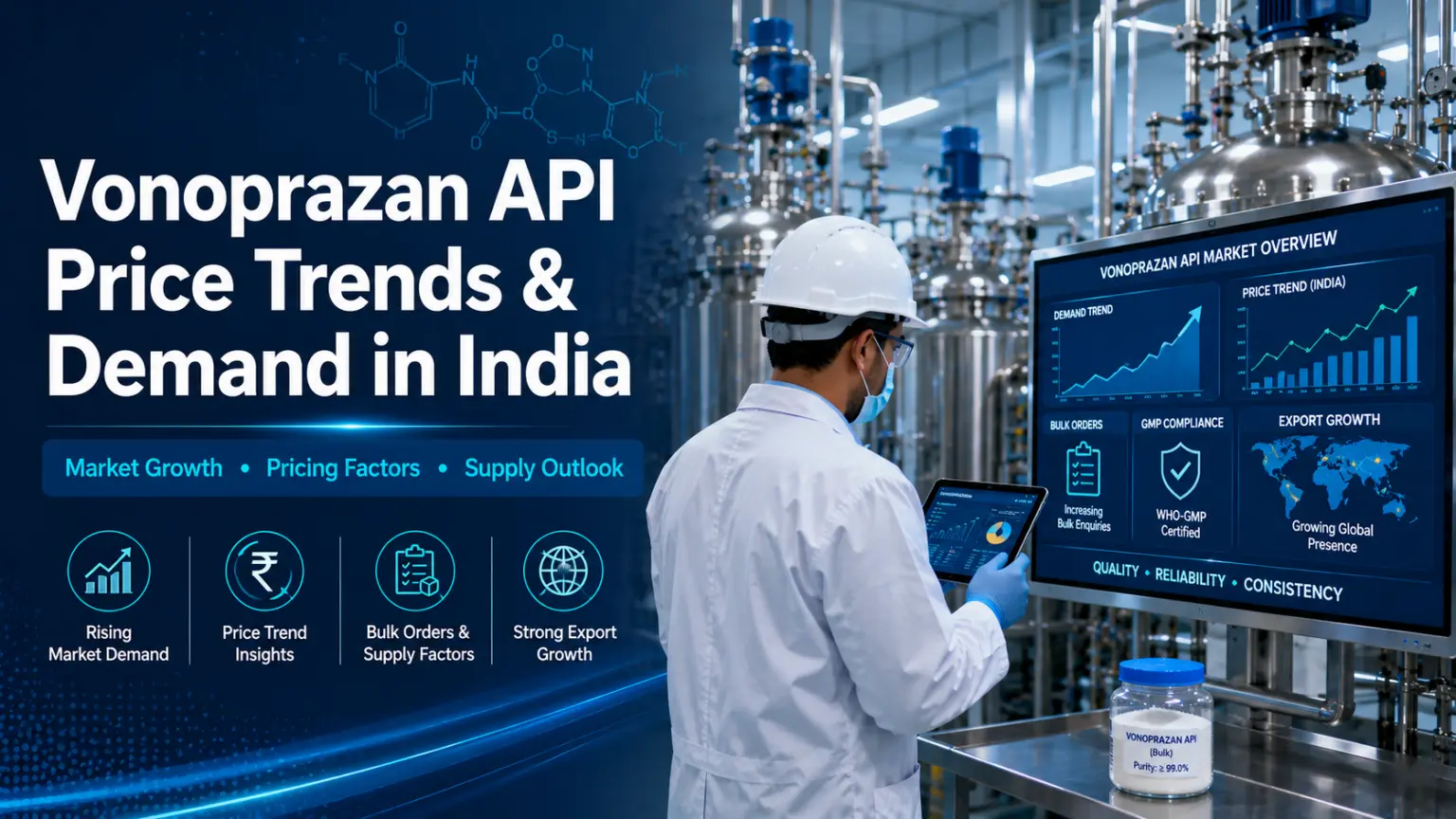
Vonoprazan API Price Trends & Demand in India
Vonoprazan API Price Trends & Demand in India
The Indian pharmaceutical industry has long been a cornerstone of global API supply, and gastrointestinal molecules are among its most actively traded categories. In recent years, Vonoprazan, a next-generation Potassium-Competitive Acid Blocker (P-CAB) has gained significant commercial traction in India, both as a finished formulation and as a bulk active pharmaceutical ingredient. For procurement teams, formulation scientists, and B2B buyers, understanding Vonoprazan API price trends and the demand landscape in India is essential to making informed sourcing decisions.
Why Vonoprazan API Demand Is Growing in India
India’s burden of acid-related gastrointestinal disorders is substantial. Gastroesophageal reflux disease (GERD), peptic ulcer disease, and H. pylori infections collectively affect tens of millions of patients annually, making acid suppressants one of the highest-volume therapeutic categories in the domestic market. Conventional proton pump inhibitors (PPIs) have historically dominated this space, but the clinical advantages of Vonoprazan faster onset, superior acid suppression, and independence from CYP2C19 polymorphism have driven a clear shift in prescriber preference.
Beyond domestic use, India-manufactured Vonoprazan API is increasingly exported to regulated and semi-regulated markets across Asia, Africa, and Latin America, further amplifying bulk demand.
Key Factors That Influence Vonoprazan API Price in India
Vonoprazan API price in India is shaped by a combination of manufacturing, compliance, and market forces. Understanding these variables helps buyers evaluate quotations accurately and build stable long-term supply relationships.
1. Raw Material and Intermediate Costs
Vonoprazan API synthesis requires two key intermediates: Pyridine-3-sulfonyl chloride and 5-(2-fluorophenyl)-1H-pyrrole-3-carbaldehyde. Manufacturers who produce these intermediates in-house rather than sourcing them from third parties exercise greater control over input costs and quality. This vertical integration is a direct pricing advantage that benefits downstream buyers through more competitive and consistent rates.
Fluctuations in solvent costs, reagent availability, and global chemical supply chains can influence input pricing, particularly for specialty fluorinated compounds used in Vonoprazan synthesis.
2. GMP Compliance and Regulatory Overheads
API pricing is inseparably linked to the level of regulatory compliance maintained by the manufacturer. WHO-GMP certified facilities must invest continuously in equipment validation, quality assurance teams, analytical infrastructure, and regulatory documentation including Drug Master Files (DMFs) and Certificate of Analysis (CoA) maintenance.
While these compliance costs are reflected in the API price, they are also the reason buyers in regulated markets demand certified supply. A GMP-certified Vonoprazan API with full documentation support offers significantly lower risk in the regulatory approval pathway compared to non-certified alternatives and that risk reduction represents real economic value. Buyers evaluating Vonoprazan API manufacturers and suppliers in India should treat GMP certification as a non-negotiable baseline, not an optional premium.
3. Order Volume and Batch Size
Like most APIs, Vonoprazan is priced on a tiered volume basis. Indicative pricing structures in India typically reflect the following dynamic:
| Order Volume | Price Tier |
|---|---|
| Up to 50 kg | Standard rate |
| 50 – 250 kg | Moderate discount |
| 250 kg – 750 kg (monthly capacity) | Best pricing tier |
Buyers placing annual volume contracts or entering CDMO partnerships generally access the most favourable pricing, along with benefits such as preferential batch scheduling and supply priority during high-demand periods.
4. In-House Intermediate Manufacturing
A critical but often overlooked pricing factor is whether the API manufacturer produces Vonoprazan intermediates in-house or sources them externally. Manufacturers dependent on third-party intermediate suppliers face exposure to supply disruptions, price volatility, and quality inconsistencies that ultimately affect both API cost and delivery reliability.
Bio-Synth manufactures both Vonoprazan intermediates internally within its Hyderabad facility, with specified purities of ≥99.0% for Pyridine-3-sulfonyl chloride and ≥95.0% for 5-(2-fluorophenyl)-1H-pyrrole-3-carbaldehyde. This integrated manufacturing model directly supports competitive, stable pricing for bulk buyers.
5. Purity Specifications and Analytical Standards
The purity grade of Vonoprazan API and the rigour with which it is tested directly affects pricing. Pharmaceutical-grade Vonoprazan with purity of ≥99%, total impurities not exceeding 1.0%, and unspecified impurities capped at 0.5% commands a justified premium over lower-specification material. Buyers should always request batch-specific CoA data and evaluate the analytical methodology used before finalising a supply agreement.
Vonoprazan API Demand Drivers: A Closer Look
Several intersecting factors are accelerating the demand trajectory for Vonoprazan API in India.
Growing formulation pipeline. Indian pharmaceutical companies are actively developing Vonoprazan-based tablets and combination products for both domestic and export markets. As more branded and generic formulations enter the market, upstream API demand grows proportionally.
Prescriber adoption of P-CABs over PPIs. The clinical differentiation of Vonoprazan from conventional PPIs is well-established. With superior efficacy in erosive esophagitis and H. pylori eradication, and a favourable safety profile with fewer drug interactions, prescribers are increasingly transitioning suitable patients to Vonoprazan-based regimens. This prescriber shift directly increases tablet production volumes and, by extension, API procurement requirements.
Export-led demand. India supplies APIs to over 200 countries. As Vonoprazan gains regulatory approvals and market access in emerging and regulated markets alike, Indian manufacturers with export-ready documentation including DMFs and regulatory dossiers are well-positioned to capture this international demand.
Combination therapy regimens. The use of Vonoprazan in triple therapy for H. pylori eradication combining it with clarithromycin and amoxicillin has expanded its indication footprint. As awareness of H. pylori-driven pathology grows and eradication rates improve with Vonoprazan-based protocols, the molecule’s clinical and commercial relevance continues to broaden.
This demand growth is not limited to Vonoprazan alone. Pharmaceutical companies building comprehensive gastrointestinal portfolios also source related APIs such as Metoclopramide API for gastroparesis and nausea management, and Posaconazole API for immunocompromised patients requiring antifungal cover all categories where India’s API manufacturing strength is well-established.
How to Evaluate a Vonoprazan API Price Quotation
For procurement professionals receiving pricing from multiple suppliers, the following checklist ensures a holistic evaluation:
Purity and impurity profile Does the CoA meet ≥99% purity with defined impurity limits? Substandard material may appear cheaper but creates downstream formulation and regulatory risk.
GMP certification status Is the facility WHO-GMP certified, and is this certification current? Buyers supplying regulated markets must verify certification directly.
Intermediate sourcing model Does the manufacturer produce intermediates in-house? This impacts price stability and supply continuity.
Batch documentation Is a full DMF available? Are stability data and analytical reports provided per batch?
Manufacturing capacity Can the supplier scale to meet growing order volumes? Capacity constraints during demand peaks create supply disruptions.
Delivery timelines Are lead times clearly defined and contractually supported?
Buyers who approach pricing evaluation with this framework are better positioned to identify genuine value from a certified supplier versus apparent savings from a non-compliant one. Exploring Bio-Synth’s API list gives procurement teams visibility into related molecules available from a single, certified source.
Vonoprazan API Supply from India: Bio-Synth’s Position
With over eight decades of API manufacturing experience and a monthly production capacity of 750 kg of Vonoprazan API, Bio-Synth occupies a strong position in the Indian Vonoprazan supply landscape. Operating from its WHO-GMP and ISO 9000:2015 certified facility in Hyderabad’s Balanagar industrial zone, Bio-Synth manufactures Vonoprazan API alongside both its intermediates entirely in-house a supply model that delivers consistent quality, competitive pricing, and reliable lead times for bulk buyers.
The facility adheres to cGMP, GLP, and GDP standards across all production batches, with robust quality control practices covering purity, potency, and impurity profiling. This positions Bio-Synth as a capable supply partner for both domestic formulation companies and international pharmaceutical buyers requiring export-grade Vonoprazan API with full regulatory documentation.
For companies also formulating therapies in adjacent therapeutic areas, Bio-Synth’s portfolio spans molecules including Resmetirom for metabolic-associated steatohepatitis and Brivaracetam for epilepsy supporting multi-molecule procurement from a single, GMP-certified source.
Conclusion
Vonoprazan API pricing in India reflects a combination of raw material costs, GMP compliance investments, manufacturing scale, and intermediate sourcing strategy. As demand for Vonoprazan continues to rise driven by prescriber adoption, expanding formulation pipelines, and export-led growth buyers who establish relationships with vertically integrated, certified manufacturers gain a clear advantage in both pricing and supply security.
To request a Vonoprazan API price quotation, discuss bulk supply terms, or review product specifications, contact the Bio-Synth team directly.
FAQ:
1. What is driving the current surge in Vonoprazan API demand in India?
A: Demand is accelerating due to three converging factors: (1) clinical shift prescribers are switching from PPIs to P-CABs based on Vonoprazan’s faster onset, superior acid suppression, and CYP2C19 independence; (2) formulation pipeline expansion Indian manufacturers are launching Vonoprazan tablets and H. pylori combination kits for domestic and export markets; and (3) export growth India-manufactured API is increasingly supplied to regulated and semi-regulated markets across Asia, Africa, and Latin America. Search data confirms this trajectory: “vonoprazan” alone generates ~30,000 monthly searches in India, with “vonoprazan 20 mg uses” and brand-related queries adding significant commercial intent volume.
2. How does vertical integration of intermediates impact Vonoprazan API pricing stability?
A: Manufacturers producing key intermediates in-house specifically Pyridine-3-sulfonyl chloride (≥99.0%) and 5-(2-fluorophenyl)-1H-pyrrole-3-carbaldehyde (≥95.0%) eliminate third-party dependency, insulating buyers from intermediate price shocks, supply disruptions, and impurity inconsistencies. This integration translates directly into competitive, stable pricing and reliable lead times. Buyers should verify intermediate sourcing models during supplier qualification, as externally dependent manufacturers pass volatility downstream.
3. What pricing tiers apply to bulk Vonoprazan API orders in India?
A: Pricing follows a standard volume-discount structure:
- Up to 50 kg: Standard rate
- 50–250 kg: Moderate volume discount
- 250–750 kg (full monthly capacity): Best pricing tier
Annual volume contracts and CDMO partnerships typically unlock the most favorable terms, including preferential batch scheduling and supply priority during demand peaks. Buyers should align procurement forecasts with these tiers to optimize unit economics.
4. Why does GMP certification affect Vonoprazan API price, and is it negotiable?
A: GMP certification is not a premium add-on it is a baseline requirement. WHO-GMP facilities invest continuously in equipment validation, QA infrastructure, analytical capabilities, and regulatory documentation (DMFs, CoAs, stability data). These compliance costs are embedded in the API price but deliver measurable value: certified API significantly reduces regulatory approval risk in regulated markets, preventing costly delays or rejection. Non-certified alternatives may appear cheaper but expose buyers to batch rejection, documentation gaps, and market access barriers. Treat GMP status as non-negotiable.
5. What should procurement teams verify beyond the per-kg price when evaluating quotations?
A: A holistic evaluation requires checking six parameters:
- Purity profile: ≥99% purity with total impurities ≤1.0% and unspecified impurities ≤0.5%
- GMP status: Current WHO-GMP certification with verifiable scope
- Intermediate model: In-house vs. third-party intermediate production
- Documentation: DMF readiness, batch-specific CoA, stability data, analytical methods
- Scalability: Monthly capacity (e.g., 750 kg) vs. your projected offtake growth
- Contractual lead times: Defined delivery schedules with penalty clauses
Apparent savings from non-compliant suppliers typically evaporate when downstream regulatory, reformulation, and supply disruption costs are factored in.
6. How does India’s position as a global API hub create export opportunities for Vonoprazan?
A: India supplies APIs to 200+ countries, and Vonoprazan is following this pathway as regulatory approvals expand in emerging and regulated markets. Indian manufacturers with export-ready documentation including DMFs, regulatory dossiers, and batch stability data are capturing international demand that domestic-only suppliers cannot access. For buyers, partnering with an export-capable manufacturer ensures supply continuity even when domestic demand fluctuates, and provides a regulatory head-start for formulations targeting global markets.


Post a comment