
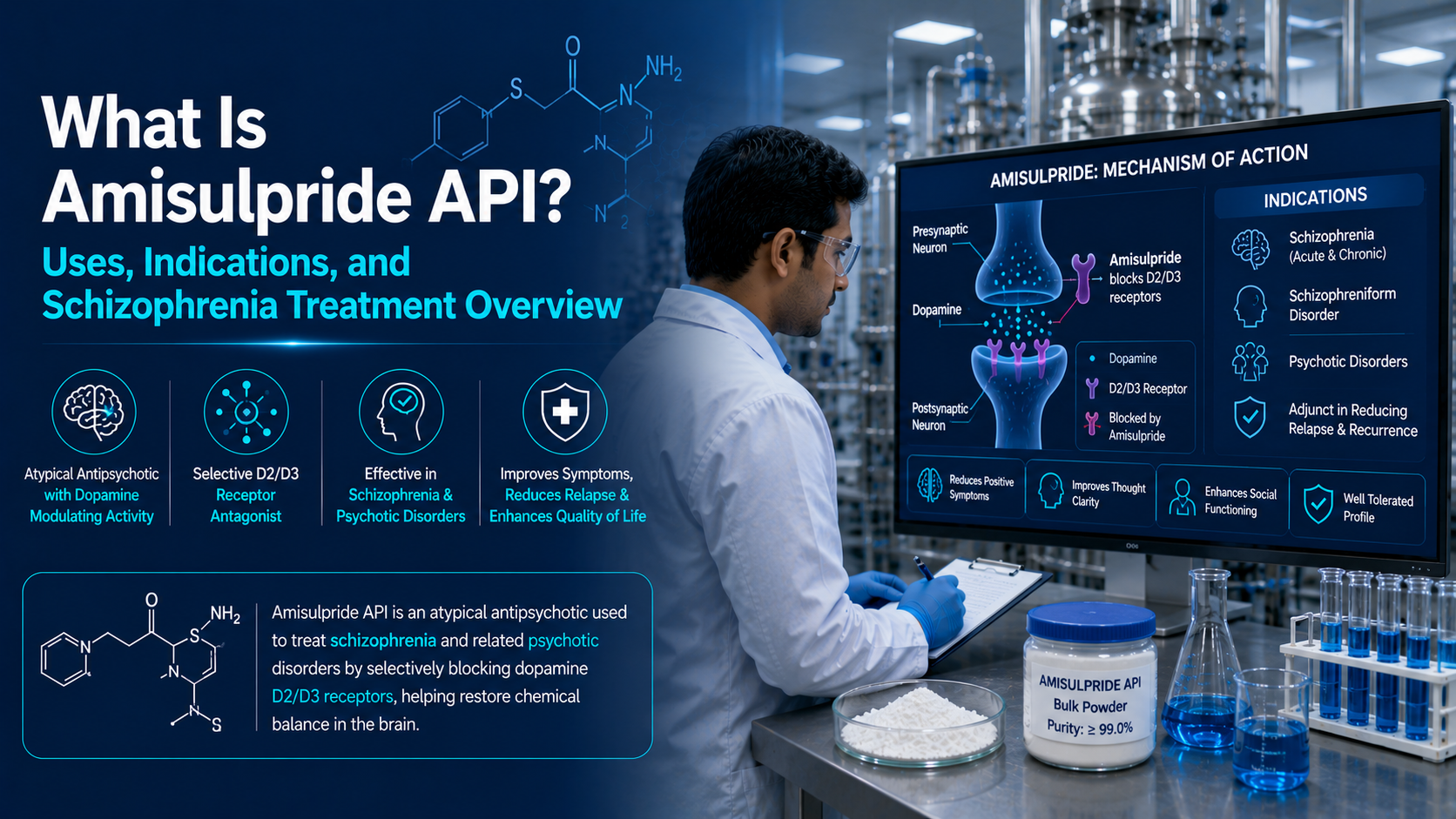
What Is Amisulpride API? Uses, Indications, and Schizophrenia Treatment Overview
What Is Amisulpride API? Uses, Indications, and Schizophrenia Treatment Overview
Amisulpride (CAS 71675-85-9) is a selective dopamine D2/D3 receptor antagonist used primarily in schizophrenia treatment. It addresses both positive symptoms (hallucinations, delusions) and negative symptoms (apathy, social withdrawal) through a unique dose-dependent mechanism. Available in BP/Ph.Eur and IP pharmacopoeial grades, it is manufactured to ≥99.0% assay purity. Biochemical and Synthetic Products Pvt. Ltd. (Bio-Synth) supplies Amisulpride with EU Written Confirmation (Certificate No. WC-0340) – a product-specific compliance document required for EU import – and holds ISO 9001:2015 certification (No. 156792-2014-AQ-IND-UKAS) covering its full API manufacturing scope.
Introduction: Why Amisulpride Matters
Schizophrenia affects approximately 24 million people worldwide – around 1 in 300 individuals – according to the World Health Organization. It remains one of the most complex psychiatric disorders to manage, requiring medications that work across a wide spectrum of symptoms. Amisulpride has emerged as a cornerstone therapeutic in this space, particularly for patients where older antipsychotics fall short on negative symptom control.
From a pharmaceutical manufacturing standpoint, Amisulpride is a high-value active pharmaceutical ingredient (API) with growing global demand. Indian API manufacturers supply a significant portion of the global antipsychotic API market, making sourcing quality and documentation compliance critical priorities for buyers.
Clinical Context
Source: WHO Fact Sheet on Schizophrenia (updated 2022). Schizophrenia affects ~24 million people globally (0.32% of the population). Effective pharmacological management with dopamine-modulating APIs like Amisulpride remains a primary treatment approach.
Amisulpride: Brand Name, Chemical Identity, and Grades
Amisulpride is marketed globally under several brand names. Solian is the most widely recognised trade name in European and Asian markets, while Amazeo is commonly used in India. The API belongs to the benzamide class of antipsychotics – a subgroup chemically distinct from phenothiazines and butyrophenones.
Chemical Profile
| Parameter | Value |
| CAS Number | 71675-85-9 |
| Molecular Formula | C17H27N3O4S |
| Chemical Class | Substituted benzamide antipsychotic |
| Pharmacopoeial Grades | BP/Ph.Eur and IP (Indian Pharmacopoeia) |
| Appearance | White or almost white crystalline powder |
| Solubility | Practically insoluble in water; freely soluble in methylene chloride; sparingly soluble in anhydrous ethanol |
Bio-Synth supplies Amisulpride in both BP/Ph.Eur and IP grades. Certificates of Analysis are batch-specific, signed by QC and QA, and include residual solvent profiling by GC-HS. Buyers requiring grade-specific documentation should specify requirements at inquiry stage.
Amisulpride in Schizophrenia Treatment
Amisulpride is approved for the management of schizophrenia, addressing both phases of symptom presentation across different dosage strategies.
Positive Symptoms of Schizophrenia
Positive symptoms – hallucinations, delusions, thought disorganisation, and agitation – are driven by dopaminergic hyperactivity in mesolimbic pathways. At doses of 400–800 mg/day, Amisulpride’s postsynaptic D2/D3 blockade effectively attenuates these symptoms, comparable in efficacy to other second-generation antipsychotics and superior to placebo in clinical trials.
Negative Symptoms of Schizophrenia
Negative symptoms – including apathy, emotional blunting, social withdrawal, alogia, and avolition – have historically been harder to treat. At lower doses (50–300 mg/day), Amisulpride preferentially blocks presynaptic autoreceptors, increasing dopamine release in the prefrontal cortex, which helps restore motivation and social engagement. This is a clinically meaningful distinction, as many antipsychotics provide limited benefit for negative symptoms.
Regulatory Note for EU Buyers
Bio-Synth holds EU Written Confirmation Certificate No. WC-0340 for Amisulpride BP/EP/IP, issued by India’s Central Drugs Standard Control Organization (CDSCO). This product-specific document is required under Article 46b(2)(b) of EU Directive 2001/83/EC for active substances imported into the EU. Current validity: 01.01.2027 (renewed March 2026).
Other Approved and Off-Label Uses
Dysthymia (Low-Dose Antidepressant Effect)
Several countries, particularly in Europe, have approved Amisulpride at low doses (50 mg/day) for the treatment of dysthymia – a chronic, low-grade depressive disorder. The presynaptic mechanism that relieves negative symptoms appears to translate into a mild antidepressant effect, making it a sometimes-preferred option for patients where standard antidepressants have not been fully effective.
Nausea and Vomiting
Amisulpride is approved in some markets, including Australia (under the brand Barhemsys/Amisole), for postoperative nausea and vomiting (PONV) prevention and treatment. This use leverages its dopamine antagonism at lower doses in the chemoreceptor trigger zone, offering an alternative antiemetic mechanism with a different side-effect profile compared to older agents like metoclopramide.
Note for procurement: Buyers sourcing Amisulpride for antiemetic formulations should specify their target pharmacopoeial grade (BP/Ph.Eur/IP) and formulation requirements at the inquiry stage, as particle size and solubility specifications may differ from antipsychotic-grade material.
Side Effect Profile: What API Buyers Need to Know
Understanding the side-effect profile of an API is critical for formulators developing patient information leaflets and regulatory dossiers. Amisulpride’s key adverse effects include:
| Side Effect | Frequency | Mechanism / Note |
| Extrapyramidal symptoms (EPS) | Less common than typical antipsychotics | Lower striatal D2 occupancy at therapeutic doses |
| Hyperprolactinaemia | Common at higher doses | D2 blockade in tuberoinfundibular pathway |
| QT interval prolongation | Dose-dependent; monitor in at-risk patients | Cardiac monitoring advised during formulation testing |
| Insomnia / agitation | Particularly at initiation | Low sedative profile vs. other antipsychotics |
| Weight gain | Moderate; lower than olanzapine | Minimal histamine/serotonin receptor activity |
API Quality Standards and Pharmacopoeial Specifications
For pharmaceutical buyers, the quality parameters of Amisulpride API must meet the applicable pharmacopoeial standard. Bio-Synth’s Amisulpride is manufactured and tested against both BP/Ph.Eur and IP specifications. Key release parameters from our
Review the complete Amisulpride API page for full grade-specific details.
| Test Parameter | Result (Typical) | Pharmacopoeial Limit |
| Appearance | White crystalline powder | White or almost white crystalline powder |
| Assay (by chemical) | ≥99.0% w/w (dried substance) | 99.0–101.0% w/w (BP/Ph.Eur & IP) |
| Related Substances (HPLC) | Total impurities ≤0.3% | As per BP/Ph.Eur/IP limits |
| Loss on Drying (105°C, 3h) | ≤0.5% w/w | Maximum 0.5% w/w |
| Sulphated Ash | ≤0.1% w/w | Maximum 0.1% w/w |
| Residual Solvents (GC-HS) | Within ICH Q3C limits | Per ICH Q3C Class 2/3 limits |
Data sourced from Bio-Synth’s Typical Certificates of Analysis (Batch ASB/011/25-26 for BP/Ph.Eur and Batch ASB/022/25-26 for IP). Actual batch data may vary; request batch-specific CoA at inquiry.
Sourcing Amisulpride API: What Procurement Teams Should Know
India is a leading global supplier of psychiatric and antipsychotic APIs, with Hyderabad-based manufacturers accounting for a substantial share of international trade. When sourcing Amisulpride, procurement officers typically need the following documentation to satisfy import authorities and regulatory dossier requirements:
- Certificate of Analysis (CoA) – full pharmacopoeial compliance report per batch
- EU Written Confirmation (for EU imports) – product-specific, per Article 46b(2)(b) of Directive 2001/83/EC
- ISO 9001:2015 certificate – covering API manufacturing scope
- ICH Q7 GMP compliance declaration – confirming quality management system documentation
- Drug License certificate – issued under the Drugs and Cosmetics Act, 1940
- TSE/BSE declaration – confirming absence of animal-derived materials in synthesis
- Stability data – supporting proposed shelf life (retest date)
Bio-Synth’s full antipsychotic and neurological API portfolio includes Amisulpride alongside other psychiatric and CNS-active ingredients. Buyers can request documentation packages for individual APIs.
Why Buyers Choose Bio-Synth for Amisulpride API
Biochemical and Synthetic Products Pvt. Ltd. – known as Bio-Synth – has been manufacturing active pharmaceutical ingredients since 1943. With over 80 years of manufacturing experience, the company operates from its facility at Phase-2, SVCIE, Balanagar, Hyderabad – a recognised hub of India’s pharmaceutical industry. Bio-synth is the leading manufacturer of Amisulpride and its intermediates in the world, with full vertical integration leading to most competitive pricing.
Verified Certifications and Compliance Documents
| Certification | Issuing Authority | Scope / Validity |
| ISO 9001:2015 (No. 156792-2014-AQ-IND-UKAS) | DNV Business Assurance, London | API manufacturing, drug intermediates; valid Aug 2023–Aug 2026 |
| EU Written Confirmation (WC-0340) | CDSCO, Ministry of Health & Family Welfare, GoI | Amisulpride BP/EP/IP – Manufacturing & Packing; valid until 01.01.2027 |
| ICH Q7 GMP Declaration | Internal QA declaration (Sr. Manager-QA) | Quality Management System documentation per ICH Q7 guidelines |
| WHO-GMP Certified Facility | Drugs Control Administration, Telangana State | Facility-level GMP certification; valid until June 2027 |
| Certified Export House | Government of India | Recognised exporter status |
Manufacturing Location Advantage
Bio-Synth’s facility in Balanagar, Hyderabad – part of Telangana’s established pharmaceutical industrial zone – offers proximity to India’s chemical supply ecosystem, skilled pharmaceutical workforce, and logistics connectivity to ports serving Europe, North America, and Southeast Asia. Hyderabad accounts for approximately 30% of India’s total API output.
Our quality and compliance documentation – including GMP certificates, CoA formats, and analytical method summaries – is available for pre-qualification and audit review on request.
Frequently Asked Questions
What is Amisulpride used for in schizophrenia treatment?
Amisulpride treats both positive symptoms (hallucinations, delusions) and negative symptoms (apathy, social withdrawal) of schizophrenia through a dose-dependent D2/D3 dopamine receptor mechanism. At low doses it disinhibits dopamine release (addressing negative symptoms); at higher doses it blocks postsynaptic receptors (addressing positive symptoms). It is one of the few antipsychotics with demonstrated efficacy specifically for negative symptoms.
What pharmacopoeial grades of Amisulpride does Bio-Synth supply?
Bio-Synth manufactures Amisulpride to BP/Ph.Eur (British Pharmacopoeia / European Pharmacopoeia) and IP (Indian Pharmacopoeia) specifications. Both grades comply with the respective monograph requirements for purity, impurity limits, residual solvents, and related substances.
What is the EU Written Confirmation for Amisulpride, and why does it matter?
The EU Written Confirmation is a mandatory document under EU Directive 2001/83/EC for active substances manufactured outside the EU and imported into European markets. Bio-Synth holds Certificate No. WC-0340, specifically issued for Amisulpride BP/EP/IP, covering Manufacturing and Packing activities. This is a product-specific document – distinct from a general GMP certificate – and is required for EU market access.
What documentation is available for Amisulpride API procurement from Bio-Synth?
Bio-Synth provides batch-specific Certificates of Analysis, EU Written Confirmation (WC-0340), ISO 9001:2015 certificate, ICH Q7 GMP compliance declaration, drug license, TSE/BSE declaration, and retest/stability data. Documentation packages can be customised based on the destination market and regulatory pathway.
Conclusion: Amisulpride API Sourced from a Trusted Manufacturer
Amisulpride remains one of the most pharmacologically interesting antipsychotic APIs on the market – its selective, dose-dependent D2/D3 mechanism gives formulators a versatile active ingredient capable of addressing the full symptom spectrum of schizophrenia. As global demand for well-documented psychiatric APIs grows, sourcing from manufacturers with verified pharmacopoeial compliance and market-specific regulatory documents is a non-negotiable priority.
Bio-Synth’s 80-year manufacturing legacy, EU Written Confirmation for Amisulpride (WC-0340), and ISO 9001:2015-certified quality system position it as a reliable long-term supplier for pharmaceutical buyers worldwide.
Ready to evaluate Amisulpride API for your formulation or regulatory dossier?
Contact Bio-Synth to request CoA samples, documentation packages, or bulk pricing. Request a quote, our QA and regulatory team responds within 1 business day.
Disclaimer: This content is intended for pharmaceutical industry professionals and is educational in nature. It does not constitute medical advice. Clinical dosing, patient suitability, and treatment decisions should be made by licensed healthcare providers. Regulatory documentation requirements vary by country; buyers should confirm import requirements with their regulatory counsel. Bio-Synth cannot guarantee specific regulatory outcomes, as these depend on country-specific authority review.


Post a comment