What Is Ethopabate API? Uses in Veterinary Medicine
What Is Ethopabate API? Uses in Veterinary Medicine
Last updated: September 2026 | Scope: Ethopabate as a veterinary active pharmaceutical ingredient – identity, grades, and where it is used. For the parasite-level detail, read the companion post on coccidiosis treatment.
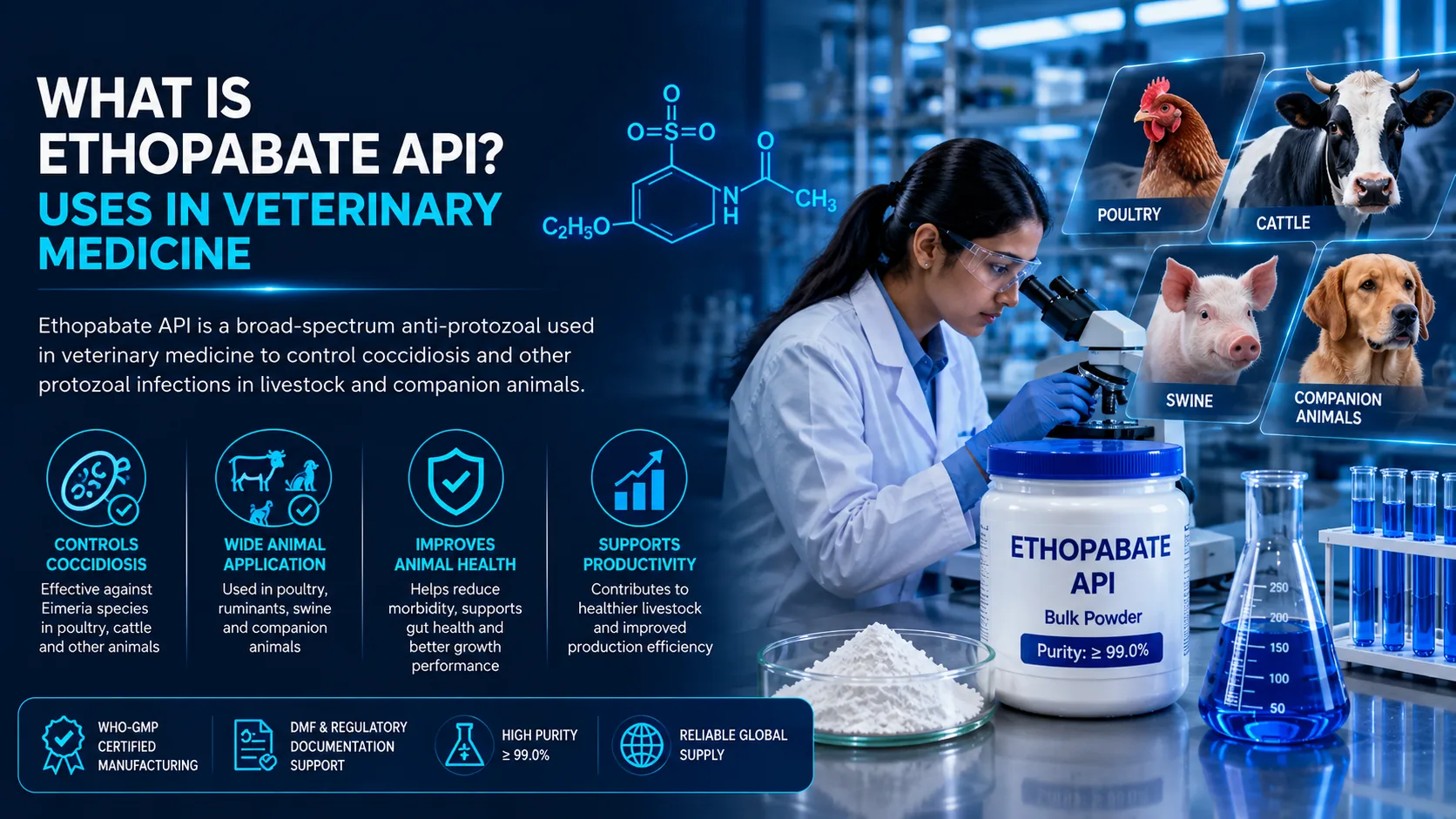
Ethopabate (CAS 59-06-3) is a synthetic, small-molecule veterinary API used as a coccidiostat in poultry. It is not a human drug. It goes into medicated feed and premixes, almost always alongside amprolium, to control intestinal coccidiosis in chickens. Bio-Synth manufactures Ethopabate to BP (Vet) and USP grades at its WHO-GMP facility in Hyderabad, and supplies it as a white to pinkish-white powder with a Certificate of Analysis.
What Ethopabate API is
Ethopabate API is an arylamide – chemically, methyl 4-acetamido-2-ethoxybenzoate. It has the molecular formula C12H15NO4 and a molecular weight of 237.25 g/mol. You may also see it listed under older names such as ethyl pabate or methyl 4-(acetylamino)-2-ethoxybenzoate.
It is a veterinary-only molecule. There is no human indication. The World Health Organization classifies it under ATCvet code QP51AX17, which places it among the antiprotozoal agents used in animals.
If you are new to the category, the short explainer on the role of active pharmaceutical ingredients covers what an API is and how it differs from the finished feed premix a farmer actually buys.
Physical form, solubility and grades
Ethopabate is supplied as a white or pinkish-white powder. It is very slightly soluble in water, soluble in chloroform and methanol, sparingly soluble in ethanol (96%) and slightly soluble in ether. That low water solubility is one reason it is dosed through feed rather than drinking water.
Two pharmacopoeial monographs govern it: the British Pharmacopoeia (Veterinary) and the United States Pharmacopeia. Both set an assay of not less than 96.0% and not more than 101.0% of C12H15NO4 on the dried basis. Bio-Synth produces both BP (Vet) and USP grades and issues a Certificate of Analysis with each batch covering appearance, identification, melting range, assay, and related tests as the monograph requires.
Storage is simple: well-closed containers, protected from light.
Where Ethopabate is used in veterinary medicine
The single established use is as an anticoccidial agent in chickens. Coccidiosis is a parasitic disease of the gut caused by Eimeria species, and it is one of the most common and costly diseases in commercial poultry. Ethopabate is added to feed to keep that infection under control during the grow-out period.
Three practical points define how it is used:
- Feed additive, not injection. Ethopabate goes into compound feed or a medicated premix. The API is milled, blended with a carrier, and then incorporated at parts-per-million levels.
- Always in combination. On its own, Ethopabate has a narrow spectrum. It is used with amprolium, a thiamine analogue that covers the Eimeria species Ethopabate misses. The two together give broader coverage than either alone.
- Intestinal, not caecal. Ethopabate is active against the intestinal species – E. acervulina and some strains of E. maxima and E. brunetti – and lacks activity against E. tenella, the caecal species. That gap is exactly why the amprolium pairing exists.
How the molecule actually interferes with the parasite, and how it fits into a feed programme, is covered in the companion post on Ethopabate in poultry coccidiosis treatment.
Who buys Ethopabate API
Buyers are veterinary formulators and feed-premix manufacturers rather than pharma companies in the human sense. What they check before qualifying a source is fairly consistent:
- Which monograph the material is released against (BP Vet or USP), and a CoA that matches it.
- Particle size and flow, because the powder has to blend uniformly into a premix at very low inclusion rates.
- Residual solvent data, since ICH Q3C (and its veterinary counterpart, VICH GL18) sets limits for APIs regardless of end use.
- Manufacturing-site credentials. A WHO-GMP certificate and an ISO 9001:2015 quality system are the usual minimum.
Bio-Synth manufactures Ethopabate at its Balanagar, Hyderabad site, which holds a WHO-GMP certificate from the Drugs Control Administration, Government of Telangana, and operates a DNV-certified ISO 9001:2015 quality system. Production follows ICH Q7 principles for API manufacture. The quality page sets out the QC and documentation practices behind each release.
The company itself dates back to 1943 and manufactures a broad small-molecule portfolio; the API portfolio page lists the current range.
Regulatory standards that apply
Veterinary APIs are held to the same manufacturing framework as human APIs. ICH Q7 sets the GMP expectations for API production. ICH Q3A and Q3B govern impurity identification and qualification, and ICH Q3C / VICH GL18 set residual solvent limits. The pharmacopoeial monograph – BP (Vet) or USP – defines the release specification.
In India, the Drugs and Cosmetics Act, 1940 and CDSCO oversight apply to the manufacturing licence. Export markets then layer their own requirements on top. The overview of API regulations and standards walks through how WHO-GMP, ICH, and pharmacopoeial standards fit together.
FAQ
Is Ethopabate used in humans?
No. It is a veterinary-only API with no human indication.
What is the CAS number of Ethopabate?
59-06-3. Molecular formula C12H15NO4, molecular weight 237.25 g/mol.
Which grades does Bio-Synth supply?
BP (Vet) and USP. Each batch ships with a Certificate of Analysis against the requested monograph.
Why is Ethopabate always combined with amprolium?
Because Ethopabate covers the intestinal Eimeria species but not E. tenella in the caeca. Amprolium fills that gap.
How should Ethopabate API be stored?
In well-closed containers, protected from light.
How do I request a specification sheet or CoA?
Use the contact page and state the grade and quantity you need.


Post a comment